Released: April 20, 2006 (JP)

Platform: Game Boy Advance
Introduction
Hello! Today I'm going to look at MOTHER 3 (or to use a less aggressive spelling, Mother 3). Mother 3 is the sequel to EarthBound, which I covered in my first post. I recommend you read it, because there are some continuities between the two games that are vital to understanding Mother 3. If you don't want to, you can still read the art, gameplay, and music sections; you might just be confused about the story/characters section in this post.
Mother 3 is unique in that it has not been released internationally. It released in 2006 exclusively in Japan, but has no official English translation. A group of dedicated fans, most prominently the professional translator Clyde "Tomato" Mandelin, worked hard for two years until they made a fan translation available. And it's an amazing fan translation that feels just like the English version of EarthBound. If you'll recall, EarthBound was known as Mother 2 in Japan, which is why Mother 3 is named the way it is.
Mother 3 is unique in that it has not been released internationally. It released in 2006 exclusively in Japan, but has no official English translation. A group of dedicated fans, most prominently the professional translator Clyde "Tomato" Mandelin, worked hard for two years until they made a fan translation available. And it's an amazing fan translation that feels just like the English version of EarthBound. If you'll recall, EarthBound was known as Mother 2 in Japan, which is why Mother 3 is named the way it is.
Gameplay
Unlike EarthBound, I really love the gameplay of Mother 3. It feels like a modern game, the overworld movement is smooth, and the battles are very strategic and fun.
/Update%2001/98-118.gif)
Battle
Mother 3 uses a very similar battle system to EarthBound, with the rolling health meter and the psychic attack system. But by timing button presses to the beat of the battle music, the player can get up to 16 hits in at once. This kind of turn-based battling is more involved than simply selecting an attack, and it reminded me of action commands from Paper Mario.
Overworld

I mentioned in EarthBound that it was easy to get characters caught on the edges of objects and buildings. In Mother 3, this was fixed, as there are no crevices for the characters to get caught on, and there's even a little satisfying 'bump' noise when you run into a wall or an object.
Speaking of running, that's another gameplay aspect that VASTLY improves this game. As much as I love EarthBound, it took SO LONG to get places. So this is a much welcomed improvement, especially because there was running in Mother, just not Mother 2/EarthBound.
Music
Mother 3's soundtrack reuses a lot of themes for different songs. This is true for the two main themes of the game, but also for a bunch of minor themes as well. When I played the game, there were times when I thought, "haven't I heard this before?", and I had. I feel like it really ties the soundtrack together, and establishes a clear 'style' that's different from EarthBound's. This may also be because Mother 3 has a different composer than the first two games.
Porky's Theme/His Highness' Theme
This theme is the theme of the antagonists of the game, Porky (Pokey) Minch and the Pigmask Army. I'll talk about Porky later, but yes, it is the same Pokey that was Ness's neighbor in EarthBound.
This theme is a march, and really gives the image of an army marching into battle. It can be heard usually when pigmasks (the soldiers in the Pigmask Army) are present. But later in the game, when the characters travel to the army-controlled New Pork City, there are a bunch of variations of the song in different styles, such as "Life's an Inner Circle Gap":
Like the Pigmask Army theme, it has been adapted to use in different situations in the game. Take this theme from the ending, which is supposed to have a creepy-yet-sad feel:
MOTHER 3 Theme of Love
This is the game's most well-known theme. It is comparable to the "Eight Melodies"/"Smiles and Tears" of EarthBound. Hinawa, the main character's mother, plays a very important role in the story, and this theme (and variations of it) often plays when there are moments with her or the rest of the family:
The love theme
Reprise of the theme
Another adaptation I really like is the version in the fighting game Super Smash Bros:
16 Melodies
I really love this song because it's a medley of the Eight Melodies from Mother 1, Smiles and Tears/Eight Melodies from EarthBound, and the Mother 3 Love Theme. It takes place at the end, and it really wraps up the whole series (the feels!):
Story/Characters
Much of the storytelling in EarthBound was done subtly, through dialogue and character interaction. Mother 3, however, has a very deliberate, dramatic, and emotional story.
**SPOILERS FOR MOTHER 3**
Overall Plot
Mother 3 takes place over a thousand years after EarthBound, as you find out in the game. The world has ended because humans have destroyed it, and the only place on the planet left is the Nowhere Islands, where this game takes place. The main character, Lucas, his twin brother Claus, his father Flint, his mother Hinawa, and his dog Boney live in a small town known as Tazmily Village. The game kicks off with Hinawa and the kids at Hinawa's father's house, getting ready to head back home. But as they begin their trip back through the forest, a mysterious army starts burning down the forest. The Drago (friendly dinosaur creatures) start acting violent, and Hinawa sends Lucas and Claus down the river.

Flint, fearing for his family's safety, organizes a search party. His kids wash up in the river, and the searchers make a fire for them. Finally, in a beautifully created scene, Flint is informed that Hinawa has been killed by a Drago. Flint breaks down, lashing out at everyone, and is thrown in jail after assaulting a few members of the search party.
The real story begins 5 years later, following Lucas. Claus has disappeared to avenge his mother's death, and is assumed to be dead. It becomes apparent that the Pigmask Army is creating combinations of animals known as chimaeras, and their leader is Porky Minch.
When the main characters finally confront Porky, he seals himself in a capsule that he can never escape, so they reach a stalemate. But Porky's minion, the Masked Man, is still trying to perform a final task to destroy the world.
The Masked Man turns out to be a cyborg the Porky made out of Claus. Upon realizing this, Flint is devastated. But through the final fight between Lucas and Claus, Lucas, unable to attack his brother, calls on his mother's spirit to convince what was left of Claus to stop trying to kill his brother. Claus realizes what he has done, and commits suicide.
It's a very emotional ending, and I teared up when I saw it the first time. As I said, this story is a lot more direct than the subtle themes of EarthBound.
 The story of Porky Minch is the main continuity between EarthBound and Mother 3. If you'll recall, Pokey Minch (known as Porky in Japan) was the kid that lived next door to Ness in EarthBound. He started out as just a mean kid who was abused at home. He wanted to be friends with Ness but didn't know how to show it. Throughout the game he became power hungry and corrupted under the evil influence of Giygas, and disappeared at the end.
In Mother 3, it is revealed that Porky is the leader of the pigmask army. He used his time machine to travel across eras and recruit for his army, his body aging thousands of years in the process. He still had the mind of a child though, and wanted to use the Nowhere Islands as his personal playplace by taking over with his army and making the animal chimaeras. In his personal city, New Pork City, there are grotesque monuments to Ness, and robotic replicas of Porky's family members.
Looking back on how Porky started out as Ness's neighbor really shows how the abuse and power affected him. The game does a good job of frustrating you, because Porky is about to end the lives of Lucas, his family, and everyone else on the Nowhere Islands for his own amusement. When Porky is finally beaten near the end of the game, he seals himself in a capsule that no one will ever be able to get into and he will never be able too escape. I thought this was a perfect end to the awful story of his life, and shows how twisted he had become.
The Masked Man turns out to be a cyborg the Porky made out of Claus. Upon realizing this, Flint is devastated. But through the final fight between Lucas and Claus, Lucas, unable to attack his brother, calls on his mother's spirit to convince what was left of Claus to stop trying to kill his brother. Claus realizes what he has done, and commits suicide.
It's a very emotional ending, and I teared up when I saw it the first time. As I said, this story is a lot more direct than the subtle themes of EarthBound.
Porky (Pokey) Minch
 The story of Porky Minch is the main continuity between EarthBound and Mother 3. If you'll recall, Pokey Minch (known as Porky in Japan) was the kid that lived next door to Ness in EarthBound. He started out as just a mean kid who was abused at home. He wanted to be friends with Ness but didn't know how to show it. Throughout the game he became power hungry and corrupted under the evil influence of Giygas, and disappeared at the end.
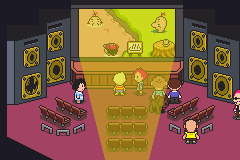 |
| New Pork City theater with a scene from EarthBound |
Looking back on how Porky started out as Ness's neighbor really shows how the abuse and power affected him. The game does a good job of frustrating you, because Porky is about to end the lives of Lucas, his family, and everyone else on the Nowhere Islands for his own amusement. When Porky is finally beaten near the end of the game, he seals himself in a capsule that no one will ever be able to get into and he will never be able too escape. I thought this was a perfect end to the awful story of his life, and shows how twisted he had become.
Background/Context
As I said in the beginning, this game has not been brought out of Japan as of now. There are rumors that it will happen soon, in the form of a digital version on the Nintendo Switch, but nothing has been confirmed. The president of Nintendo of America has given a strong hint, though.
Mother 3 is currently the only Mother game that has not been released worldwide. EarthBound, or Mother 2, was released in the U.S. in 1995, and later released on the Wii U in 2013 where the whole world had access to it. In 2015, Nintendo released EarthBound Beginnings on the Wii U, which was a translated version of the first Mother game that had never been released outside of Japan. Mother 3 was released on the Japanese Wii U shop, but not anywhere else.
The Mother 3 fan translation is a professional-grade translation, as I mentioned. It came out in 2008, two years after the game's Japanese launch. I played the translation, and it's really amazing. If you feel intimidated by figuring out how to use the fan translation, you can always watch someone play the game on YouTube, or watch someone stream it. I recommend Lauren the Flute's playthrough, as it was her first time playing the game and I like how she breaks the game down as she plays it.
Notes
Next is Wind Waker! I extended the Up Next list to 10 games, and I added a Sometime In The Future list for games that I plan to do sometime but not in order.


