In this blog I reflect on individual video games I have played over the years (mostly Nintendo games, 'cause that's what I play). I try to introduce the game to people who haven't played it before, and to give my feelings on the game so people who are familiar with it can see my perspective.
I'll also talk about the history of the games and any insight the developers have given on the process behind creating them.
Breath of the Wild has a surprisingly low amount of music compared to other Zelda games. Most of the time, when Link is traversing the overworld, there isn't any music aside for the occasional few piano notes.
That being said, this game does have its share of great songs, just a significantly smaller share than other Zelda games. This isn't because the songs aren't good, of course, it's just because there aren't very many. One which stands out to me is the Hyrule Castle theme, a sweeping, epic song that is befitting of the game's final battle, and that pulls from the series' many past themes.
Most of the soundtrack, however, consists of background piano music, which consists of flourishes and the occasional simple melody. This is what plays when roaming the vast fields of Hyrule, most of the game's world, and it captures the game's atmosphere in a way I can only describe as masterful.
Some have bemoaned the lack of more traditional songs, as past Zelda games have had. But the primary function of music in a game is to complement that game, not necessarily to provide a soundtrack that can stand on its own (although this is definitely not uncommon).
Manaka Kataoka, one of the two primary composers, had never worked on a game of this scale, and was known as the composer for Animal Crossing games (a Nintendo series about managing a town of animal residents). But her music in this game has fit perfectly with what the game was trying to capture. She also composed the theme for one of the first trailers, a theme that left many fans in awe as they watched for the first time.
(I meant to finish this post last year but never did, so I thought I might as well publish it)
Guys. This is an amazing game. I feel like this is one of those landmark games, like Super Mario Bros, LOZ: Ocarina of Time, and Final Fantasy VII. I'm serious. But only time will tell.
If you've never played a Zelda game before this one, fear not. If you haven't played many video games before this one, fear not. Because even though this game can be hard at times, it isn't the kind of hard that requires technical skill, it's the kind of hard that requires you to think critically, and everyone (most people) can do that.
Part 1? What are you trying to pull?
Sorry, but there's so much I have to say about this game that squeezing it into a single post would be unpleasant for everyone. There will be a second one soon, and at the bottom of this post you can see exactly what it will cover. I'm going to split some categories over both parts.
In past Zelda games, there were specific methods of getting to different places and solving certain puzzles. In Ocarina of Time, to get to the Gerudo Desert, you had to use the hookshot to breach Gerudo Valley. The world had walls everywhere, and you could only approach most locations from one direction. In Breath of the Wild, however, the map is seamless, and you can approach every location from all directions. To get to Kakariko Village, you could certainly take the path that leads to the gate of the village, but you can also walk up the field to the west to find another path, or even go around and climb up the mountains from the north to drop down on the houses.
Link floats upwards after setting grass on fire
Many methods of getting around the world involve the natural mechanics Breath of the Wild introduces. Simple things, like cutting down a tree to cross a chasm, or using the paraglider to catch an updraft from some burning brush, can help Link reach new places. In this way, the game is very friendly to inexperienced gamers. Simple problem solving skills are the only thing required to reach one of many solutions to each of the game's puzzles.
Shrines/Dungeons
From my Majora's Mask and Wind Waker posts, you may be familiar with the focus of dungeons in the Zelda series. If not, just know that dungeons are elaborate labyrinths with a sequence of puzzles and enemy fights, culminating in a boss fight at the end.
In BOTW, there are only four dungeons. Each one takes place in a "Divine Beast", one of four animal-shaped mechanical creatures intended to protect Hyrule from Ganon. Compared to dungeons in other games, they're pretty simplistic. I wish they were more like dungeons in other games, but I can see that the developers chose to focus on the overworld.
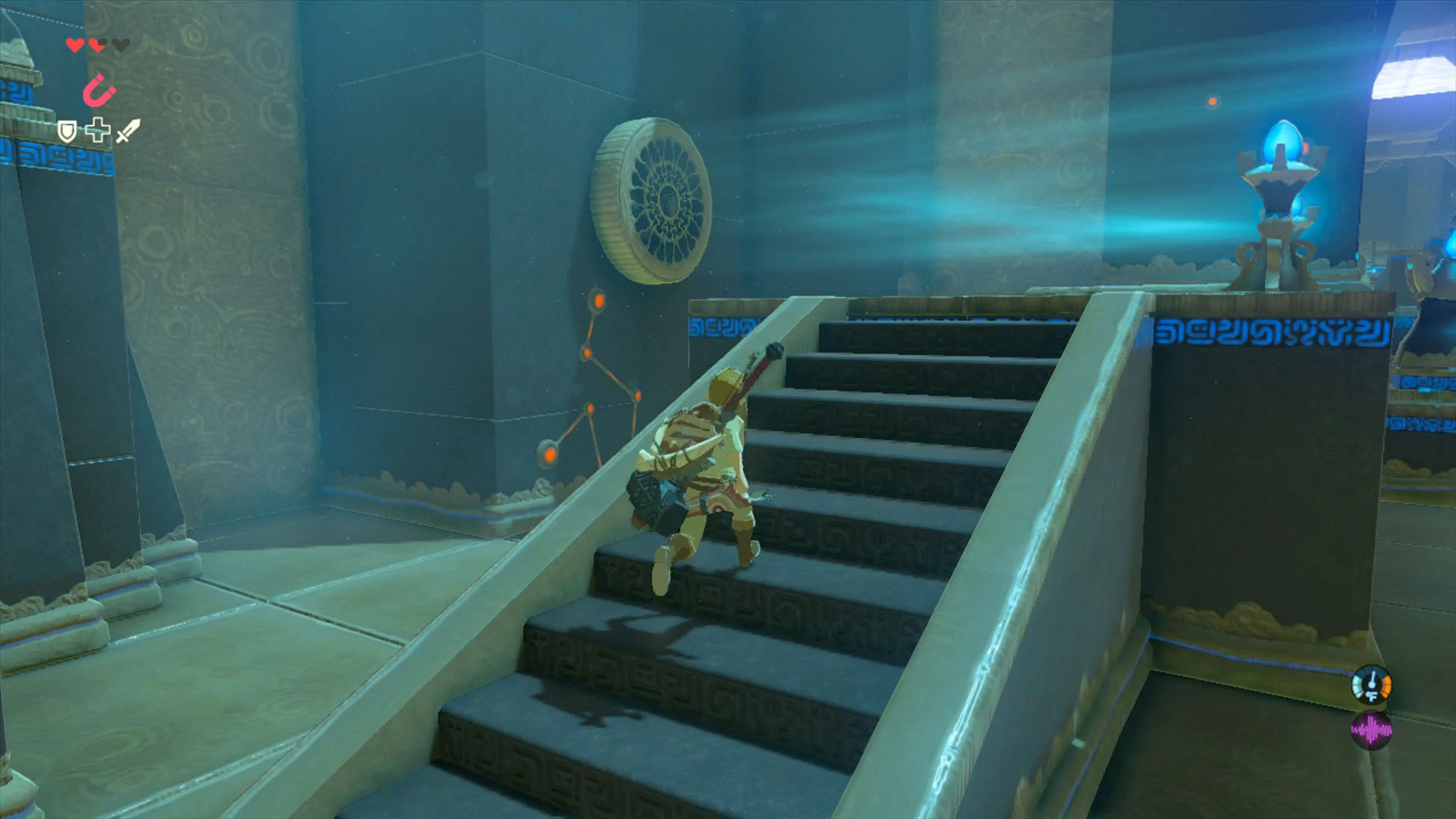
A wind puzzle in a shrine
To make up for the lack of dungeons, there are 120 'shrines' scattered all over the world. These are sort of like dungeons, but are very short, focusing on one concept for a puzzle. Some are very short, with just one puzzle, and others can be longer, with 5 or 6. I actually liked the concept of shrines, because the puzzles were always very unique and creative, and required some real thinking. In some other Zelda games, dungeon puzzles often were as simple as sliding block puzzles, so this was welcome.
Abilities
At the beginning of the game, Link gains a few core abilities that are used all throughout the game, from traversing the world to aiding in combat to solving puzzles in shrines. Remote Bombs are energy blasts which Link can detonate from a distance. Magnesis lets him manipulate metal objects through the air. Stasis locks an item in place for a short time. During this time, one thing Link can do is hit the object repeatedly to build up force, causing the object to experience the combined force once Stasis runs out. Cryonis makes a pillar of ice rise from a body of water, which can lift up gates, help Link traverse water, etc.
I love the abilities because using them in tandem creates some really interesting puzzles, combat methods, and even exploits.
Story/Characters (champions)
In Breath of the Wild, Link wakes up in a preservation chamber 100 years after a great calamity struck Hyrule. During that calamity, there were four "champions" who helped Link and Zelda (try to) defeat Ganon. They died in the struggle, but through memories and ghostly apparitions, the player gets to know each of the four champions. They're strong characters, in my opinion.
Mipha
Mipha is a member of the sea-dwelling Zora race, and she had a crush on Link since their childhood together. She is quiet and shy, but she shows resilience in the face of danger. I like how she is dedicated to helping Zelda even though she knows Link has feelings for Zelda. Mipha is said to be quite handy with a spear, and she pilots the elephant divine beast Vah Ruta. I'm not a huge fan of her voice actor, though.
Revali
Revali is a Rito, a race of bird people. He's arrogant, but lovable at the same time. He resents Link for being the Hero of Legend, believing himself to be more skilled than Link is. When Link meets Revali's spirit after completing the dungeon in Revali's Divine Beast, he finally acknowledges Link's skill. Revali's confidence makes him memorable, and I actually like his voice actor.
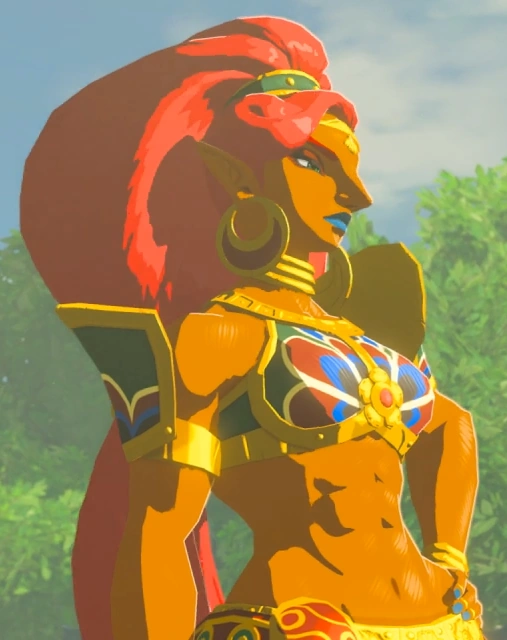
Urbosa
Urbosa is the chief of the Gerudo, a race of women living in the desert. She is seen acting like a big sister to Zelda, and she has some pretty kick-ass lightning powers. In the group of champions, she seems to be the wisest, and the one who maintains order. She also has a surprising hunger for revenge against Ganon, and she relishes the chance to help in defeating him.
Daruk
Daruk is a Goron, a rock creature who lives near the volcano. He's the least developed character, but from flashbacks it can be seen that he acts like a big brother toward Link. There's also a touching scene where Daruk's descendant sees his spirit. The excitement and sadness are almost tangible in the young Goron's expression.
Art
This game uses a cell-shaded graphical style, which I think suits it very well. It looks a lot like Studio Ghibli films, and its style was inspired by traditional Japanese animation.
Ahhhhh
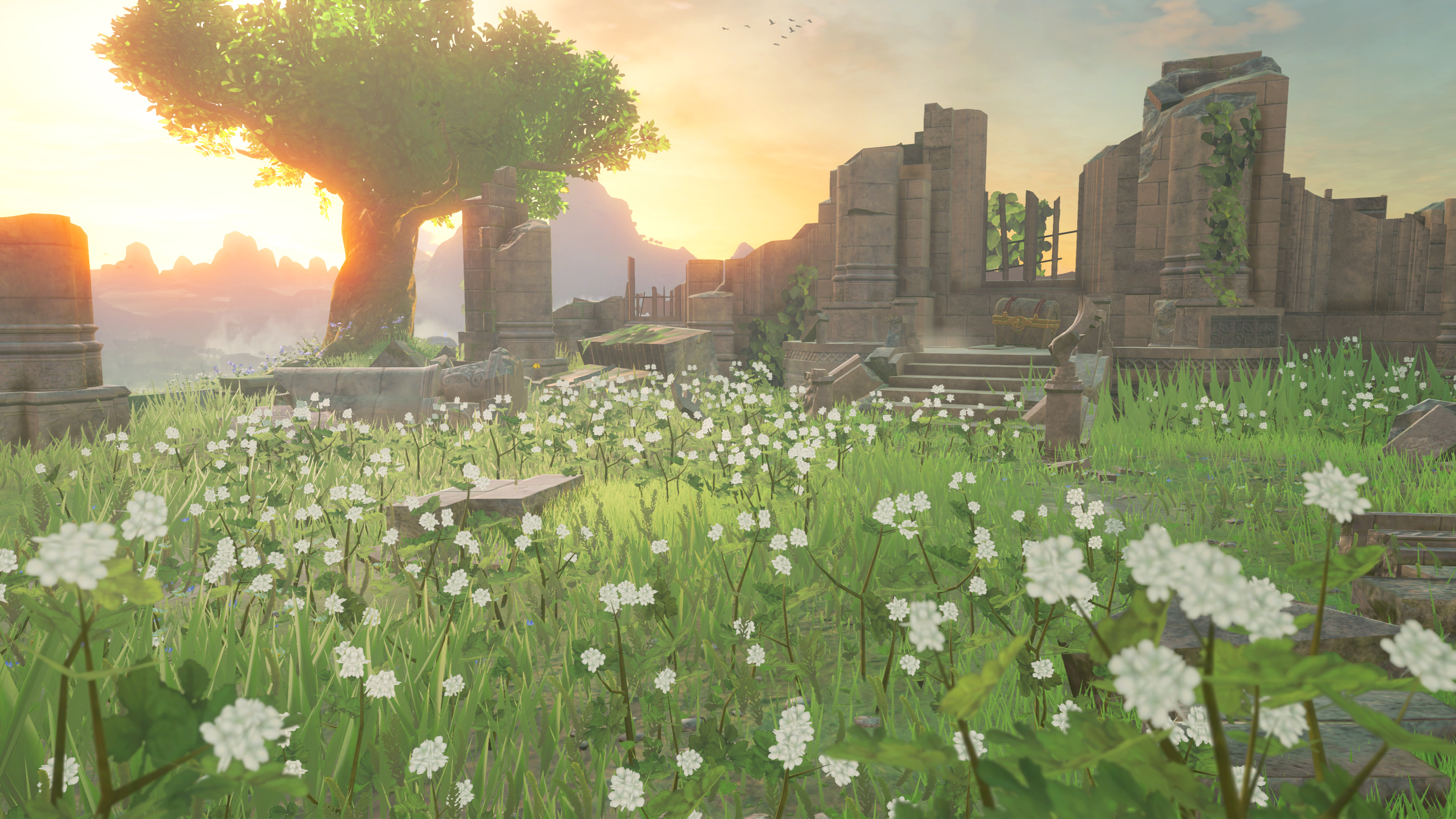
The open world of Breath of the Wild combined with the artstyle make screenshots of this game look like paintings. Any shortcomings in the Nintendo Switch's graphical capabilities are masked by the style.
Be still, my heart
The characters also benefit from the style. The features in their faces are more pronounced, making them more expressive and letting the developers convey emotions with subtleties in the faces.
Part 2
Part two will include Gameplay (combat, food, and quests), Music, and Characters/Story (Zelda and Link). I hope to have it out in a week.
Paper Mario: The Thousand Year Door is the 2004 sequel to the 2001 Paper Mario. Unlike later games in the series, it keeps the same core gameplay as the original game. Most Paper Mario fans say this is their favorite game in the series because of how well it expands on the first game.
I recommend you read the gameplay section my post on the first Paper Mario game, just to get the gist of it. You'll want to know what partners are, and how the battle system works. Without further ado, let's begin.
Gameplay
The first game, while using paper as a unique artsyle, didn't really do much with the paper theme when it came to gameplay. But in this game, Mario gets different paper abilities, like folding into an airplane, that enhance the game. My favorite is his ability to turn sideways to squeeze through cracks, a simple yet ingenious idea that allows for clever puzzles. After he gets this ability, Mario can slip between buildings, down a sewer grate, and through jail bars.
The abilities the partner characters give you are interesting as well. For example, Flurrie blows air that "blows away" pieces of the environment to reveal secrets and hidden areas.
The overworld is laid out much like the first Paper Mario game: different sections of the world all connect to a central hub town. In this game, it's Rogueport: a grungy port town with shady characters and a conflict between two gangs. Rogueport was, in my opinion, a fresh departure from the traditional cutesy locations Mario games are known for.
Battle
The Thousand Year Door returns with a very similar battle style to that of the first game. Mario still takes turn attacking the enemy, with the assistance of one partner at a time, and having the enemy take a turn attacking him. In this game, however, the battles have more complexity and strategy. The partner character now have their own health meters, and can swap positions with Mario if he is low on health.
In addition to timing a tap of the "A" button to reduce the damage from enemy attacks, pressing the "B" button negates all damage and does damage to the enemy, albeit requiring much harder timing.
Music
I'm conflicted about this game's music. I find some of the instruments used to be kind of annoying, but there are some really good themes. Here is one that I liked regardless of the instruments:
The theme is from the game's opening, and I love it because of how mysterious it sounds. It plays while the story of the ancient city beneath Rogueport is being told.
Some music was more atmospheric than melodic, which I usually liked. Here's Boggly Woods, which really goes with the area's look of the black and white trees and the shimmering ground:
Boggly Woods
Characters/Some Story
Like the first game, the story is a pretty simple one, if a little less like other Mario games. That's not necessarily a bad thing, however. The story that is there is heartwarming, memorable to many Nintendo fans, and leaves the player feeling satisfied. The characters really shine, though, and the simple story puts them in the spotlight. The Thousand Year Door is the most popular Paper Mario game because of its characters, which should be no surprise.
Partners
Like the first game, TTYD has partners that join Mario on his quest as the game progresses. The main partner, while still a goomba, is much more interesting than Goombario from the first game. Her name is Goombella, and she is an archeology student studying under Professor Frankly at the University of Goom (gooo goombas!). Her spunky commentary on enemies and areas makes the game more interesting.
Madame Flurrie (the one with the...shapely body) is a retired movie star longing to return to the stage. She's also a wind spirit, somehow? Flurrie is great, though, yet another interesting character.
Admiral Bobbery is an old sea captain who never forgave himself after his wife died while he was at sea. His story is one of the more emotional parts of the game, and I had a reaction to it similar to my reaction to Rosalina's Storybook in Super Mario Galaxy.
Vivian is originally an enemy, a member of the Shadow Sirens. But she is emotionally abused by her sisters, and ends up joining Mario's side after he treats her with kindness. In battle she uses cool fire attacks, so thats a plus too.
Princess Peach and the Shadow Queen
**minor spoilers**
Princess Peach, normally a passive character in the Mario Series, has a surprisingly defined personality in this game. She does still get kidnapped, but in the game's intermissions the player can once again control her as she sneaks around. In TTYD, the princess is kidnapped by an alien clan known as the X-Nauts, and she sneaks around the X-Nauts' lunar base to email information to Mario.
Peach and TEC-XX
The princess's stories, which took place between the chapters, I found to be surprisingly entertaining. The main plot revolves around Peach befriending the base's main computer, TEC-XX (based on HAL from the movie 2001: A Space Odyssey). She teaches the computer about the concept of love in exchange for security clearance as she sneaks around the base. In one surprisingly risqué scene, Peach has to strip down naked after TEC made her invisible. Being invisible, she obviously didn't show anything, but it's not something you usually expect from a Mario game.
Ultimately, Peach makes a strong connection with TEC and gets him to betray the X-Nauts. I loved it when this story converged with the main story, but I always love when storylines converge, so idk if that's a plus.
**major spoilers to a 2004 game, you have been warned**
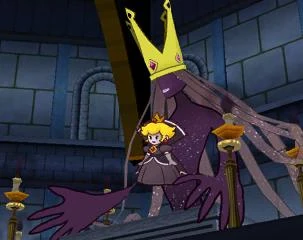
In the final scenes of the game, the leader of the X-Nauts lets loose the Shadow Queen, a demon who was trapped in the ancient city beneath Rogueport. The Shadow Queen uses Peach as a vessel, and possesses her body for an amazing final boss battle against Mario and his partners. There's a scene where all the candles in the room go out, and then are lit with black fire one by one, which was a deliciously creepy touch.
The Shadow Queen, the Peach storyline, and the setting of Rogueport all give The Thousand Year Door its unique personality. It's edgier than most, if not all other Mario games, but it doesn't take itself too seriously so it doesn't get into the "cringy" territory (see: Shadow the Hedgehog)
Playing this Game
Can I play this game?
To play this game legitimately, you need a GameCube or a Nintendo Wii system. You're more likely to have a Wii, which can play GameCube games thanks to backwards compatibility. You also need a GameCube Controller and a memory card, both of which are pretty inexpensive, especially if they're used.
Should I play this game?
Paper Mario: The Thousand Year Door is a great game for non-gamers, in my opinion. The game requires little technical skill, and like many Nintendo games is designed with new gamers in mind. The lighthearted plot and memorable characters will make this game stand out to even the most skeptical.
If you ARE a Nintendo gamer and haven't played this, game, what are you waiting for? This game needs to be played YESTERDAY!
Hello! Today I'm going to look at MOTHER 3 (or to use a less aggressive spelling, Mother 3). Mother 3 is the sequel to EarthBound, which I covered in my first post. I recommend you read it, because there are some continuities between the two games that are vital to understanding Mother 3. If you don't want to, you can still read the art, gameplay, and music sections; you might just be confused about the story/characters section in this post.
Mother 3 is unique in that it has not been released internationally. It released in 2006 exclusively in Japan, but has no official English translation. A group of dedicated fans, most prominently the professional translator Clyde "Tomato" Mandelin, worked hard for two years until they made a fan translation available. And it's an amazing fan translation that feels just like the English version of EarthBound. If you'll recall, EarthBound was known as Mother 2 in Japan, which is why Mother 3 is named the way it is.
Gameplay
Unlike EarthBound, I really love the gameplay of Mother 3. It feels like a modern game, the overworld movement is smooth, and the battles are very strategic and fun.
Battle
Mother 3 uses a very similar battle system to EarthBound, with the rolling health meter and the psychic attack system. But by timing button presses to the beat of the battle music, the player can get up to 16 hits in at once. This kind of turn-based battling is more involved than simply selecting an attack, and it reminded me of action commands from Paper Mario.
Overworld
I mentioned in EarthBound that it was easy to get characters caught on the edges of objects and buildings. In Mother 3, this was fixed, as there are no crevices for the characters to get caught on, and there's even a little satisfying 'bump' noise when you run into a wall or an object.
Speaking of running, that's another gameplay aspect that VASTLY improves this game. As much as I love EarthBound, it took SO LONG to get places. So this is a much welcomed improvement, especially because there was running in Mother, just not Mother 2/EarthBound.
Music
Mother 3's soundtrack reuses a lot of themes for different songs. This is true for the two main themes of the game, but also for a bunch of minor themes as well. When I played the game, there were times when I thought, "haven't I heard this before?", and I had. I feel like it really ties the soundtrack together, and establishes a clear 'style' that's different from EarthBound's. This may also be because Mother 3 has a different composer than the first two games.
Porky's Theme/His Highness' Theme
This theme is the theme of the antagonists of the game, Porky (Pokey) Minch and the Pigmask Army. I'll talk about Porky later, but yes, it is the same Pokey that was Ness's neighbor in EarthBound.
This theme is a march, and really gives the image of an army marching into battle. It can be heard usually when pigmasks (the soldiers in the Pigmask Army) are present. But later in the game, when the characters travel to the army-controlled New Pork City, there are a bunch of variations of the song in different styles, such as "Life's an Inner Circle Gap":
MOTHER 3 Theme of Love
This is the game's most well-known theme. It is comparable to the "Eight Melodies"/"Smiles and Tears" of EarthBound. Hinawa, the main character's mother, plays a very important role in the story, and this theme (and variations of it) often plays when there are moments with her or the rest of the family:
The love theme
Reprise of the theme
Like the Pigmask Army theme, it has been adapted to use in different situations in the game. Take this theme from the ending, which is supposed to have a creepy-yet-sad feel:
Another adaptation I really like is the version in the fighting game Super Smash Bros:
16 Melodies
I really love this song because it's a medley of the Eight Melodies from Mother 1, Smiles and Tears/Eight Melodies from EarthBound, and the Mother 3 Love Theme. It takes place at the end, and it really wraps up the whole series (the feels!):
Story/Characters
Much of the storytelling in EarthBound was done subtly, through dialogue and character interaction. Mother 3, however, has a very deliberate, dramatic, and emotional story.
**SPOILERS FOR MOTHER 3**
Overall Plot
Mother 3 takes place over a thousand years after EarthBound, as you find out in the game. The world has ended because humans have destroyed it, and the only place on the planet left is the Nowhere Islands, where this game takes place. The main character, Lucas, his twin brother Claus, his father Flint, his mother Hinawa, and his dog Boney live in a small town known as Tazmily Village. The game kicks off with Hinawa and the kids at Hinawa's father's house, getting ready to head back home. But as they begin their trip back through the forest, a mysterious army starts burning down the forest. The Drago (friendly dinosaur creatures) start acting violent, and Hinawa sends Lucas and Claus down the river.
Flint, fearing for his family's safety, organizes a search party. His kids wash up in the river, and the searchers make a fire for them. Finally, in a beautifully created scene, Flint is informed that Hinawa has been killed by a Drago. Flint breaks down, lashing out at everyone, and is thrown in jail after assaulting a few members of the search party.
The real story begins 5 years later, following Lucas. Claus has disappeared to avenge his mother's death, and is assumed to be dead. It becomes apparent that the Pigmask Army is creating combinations of animals known as chimaeras, and their leader is Porky Minch.
When the main characters finally confront Porky, he seals himself in a capsule that he can never escape, so they reach a stalemate. But Porky's minion, the Masked Man, is still trying to perform a final task to destroy the world.
The Masked Man turns out to be a cyborg the Porky made out of Claus. Upon realizing this, Flint is devastated. But through the final fight between Lucas and Claus, Lucas, unable to attack his brother, calls on his mother's spirit to convince what was left of Claus to stop trying to kill his brother. Claus realizes what he has done, and commits suicide.
It's a very emotional ending, and I teared up when I saw it the first time. As I said, this story is a lot more direct than the subtle themes of EarthBound.
Porky (Pokey) Minch
The story of Porky Minch is the main continuity between EarthBound and Mother 3. If you'll recall, Pokey Minch (known as Porky in Japan) was the kid that lived next door to Ness in EarthBound. He started out as just a mean kid who was abused at home. He wanted to be friends with Ness but didn't know how to show it. Throughout the game he became power hungry and corrupted under the evil influence of Giygas, and disappeared at the end.
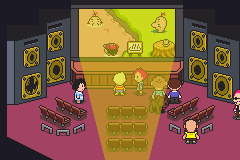
New Pork City theater with a scene from EarthBound
In Mother 3, it is revealed that Porky is the leader of the pigmask army. He used his time machine to travel across eras and recruit for his army, his body aging thousands of years in the process. He still had the mind of a child though, and wanted to use the Nowhere Islands as his personal playplace by taking over with his army and making the animal chimaeras. In his personal city, New Pork City, there are grotesque monuments to Ness, and robotic replicas of Porky's family members.
Looking back on how Porky started out as Ness's neighbor really shows how the abuse and power affected him. The game does a good job of frustrating you, because Porky is about to end the lives of Lucas, his family, and everyone else on the Nowhere Islands for his own amusement. When Porky is finally beaten near the end of the game, he seals himself in a capsule that no one will ever be able to get into and he will never be able too escape. I thought this was a perfect end to the awful story of his life, and shows how twisted he had become.
Background/Context
As I said in the beginning, this game has not been brought out of Japan as of now. There are rumors that it will happen soon, in the form of a digital version on the Nintendo Switch, but nothing has been confirmed. The president of Nintendo of America has given a strong hint, though.
Mother 3 is currently the only Mother game that has not been released worldwide. EarthBound, or Mother 2, was released in the U.S. in 1995, and later released on the Wii U in 2013 where the whole world had access to it. In 2015, Nintendo released EarthBound Beginnings on the Wii U, which was a translated version of the first Mother game that had never been released outside of Japan. Mother 3 was released on the Japanese Wii U shop, but not anywhere else.
The Mother 3 fan translation is a professional-grade translation, as I mentioned. It came out in 2008, two years after the game's Japanese launch. I played the translation, and it's really amazing. If you feel intimidated by figuring out how to use the fan translation, you can always watch someone play the game on YouTube, or watch someone stream it. I recommend Lauren the Flute's playthrough, as it was her first time playing the game and I like how she breaks the game down as she plays it.
Notes
Next is Wind Waker! I extended the Up Next list to 10 games, and I added a Sometime In The Future list for games that I plan to do sometime but not in order.
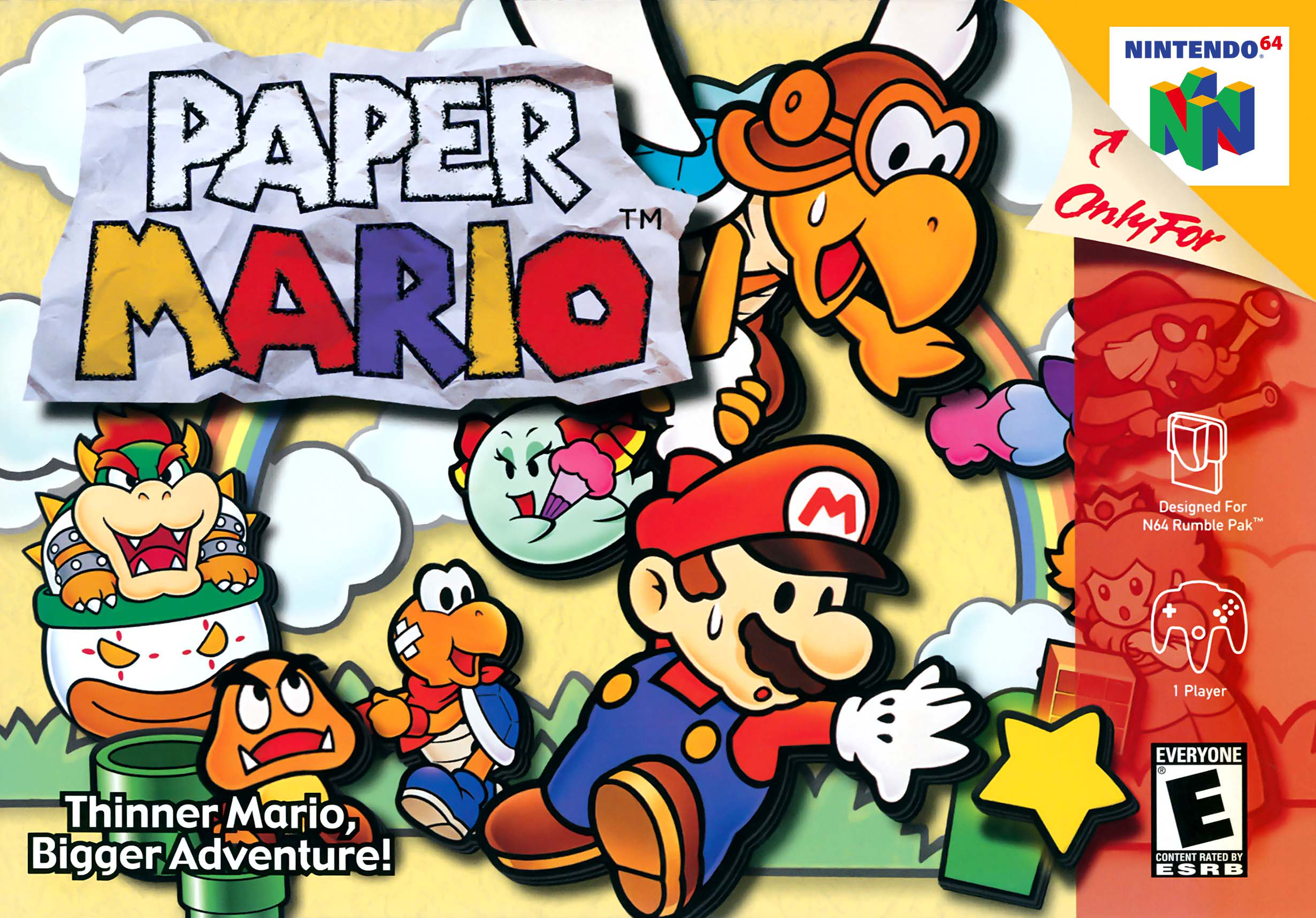
Released: August 11, 2000 (JP), February 5, 2001 (USA)
Platform: Nintendo 64
Introduction
Paper Mario is one of Nintendo's first takes on the JRPG (Japanese Role Playing Game) genre. It is considered to be the spiritual successor to Super Mario RPG, which was Nintendo's first JRPG, and includes many twists on the JRPG formula. Like RPGs, there are turn-based battles (Mario attacks, the enemy attacks, Mario attacks, etc...). But button presses can be times to increase the damage Mario deals and reduce the damage he receives, which was one of the many Nintendo-style twists to the genre's formula.
Unlike main series Mario games, Paper Mario has a greater focus on story and characters. The game also has a cartoonish, and sometimes dry, sense of humor. Paper Mario series fans consider this game and the second one to be the best in the series, so this game is usually remembered fondly. And though it was on the 90's-era Nintendo 64, the game has aged well because of its paper artstyle.
CHARM
Impressions
When I first played Paper Mario in 7th grade, I was immediately in love with the charm of the game. Everything, from the art style, to the battles, resonates such a pure Nintendo charm that few other games can rival. The cast of characters, specifically Mario's battle partners, also stick out to me, as they all have unique designs and often a witty sense of humor.
Gameplay
Overworld
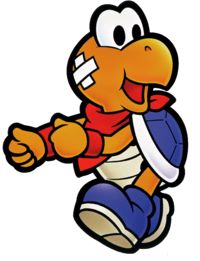
In Paper Mario, the player controls Mario in his adventure through the Mushroom Kingdom. In addition to moving around the 3D areas, Mario can use a hammer and jump a short difference. Along the way, Mario meets 8 characters who act as "partners". One partner follows Mario at a time, and partners can be switched at will. In the world, each partner has an ability that can help Mario, like lighting up a dark area, carrying him over small gaps (picture above), or letting him swim through water.
Mario uses his partner Sushie to swim
Battles
In battle, Mario similarly has the option to attack with either with his hammer or by jumping on the enemy. There's a strategy here, because Mario will get hurt if he tries to jump on some enemies (often wearing spikes), and his hammer can't reach flying enemies. In battle, both Mario and his current partner can attack once each turn, and the partners have unique attacks that often are similar to their abilities in the overworld. If there's a flying enemy that is wearing spikes, one of the partners' moves is probably necessary.
Battling with a partner
Artstyle
A pretty big part of Paper Mario, and the game's namesake, is its paper artstyle. All of the characters and items in this game are 2D, in a "paper" style, even though the environments and worlds are 3D. When Intelligent Systems made this game they weren't very familiar with making a 3D game, so thats why they went with this style. There are little winks and nods to the paper theme throughout the game, like how when a bridge is built, the screen turns like a page to reveal a bridge behind it. In fact, the game is organized into 'chapters', like a book.
Aside from that, there's really not a lot of gameplay that centers on the idea of paper. It's more of a unique artstyle than anything else.
Characters
While the characters I talked about in Bayonetta 2 and Fire Emblem are like characters from a novel, Paper Mario's characters are more like characters from a storybook, or a fairy tale: they lack much depth, but they seem real. Paper Mario uses these characters to weave a vivid world. I haven't played this game in a few years, but I can remember even the most minor characters because of how unique they are.
The partner characters, as I mentioned before, follow Mario throughout the game once they join his party. Each one is visually distinct and has a different personality. It's hard to explain, but having 8 characters with personalities follow me in game makes it seem like an adventure with friends.
Notes
You may have noticed that I included fewer categories in this post, which is partly because this game isn't noteworthy in all of its aspects, and partly because I'm trying to cut down on the post lengths. Hopefully it will be more readable if its shorter.
Released: April 19, 2012 (JP), February 4, 2013 (USA)
Platform: Nintendo 3DS
Introduction
Fire Emblem Awakening is a strategy game released for the Nintendo 3DS. It is the 13th game in the Fire Emblem series, a series that made its debut in 1990, but didn't have any worldwide releases until the 7th game in the series.
The Fire Emblem games are strategy games, and the player must move characters around a battlefield, and the must take turns with the enemy team. Think of it like chess, if you were able to move all of your pieces each turn and if the chess board was much bigger.
Fire Emblem Awakening also has a big focus on characters and story. Each unit has their own personality and backstory. If a character dies in a level, they are dead for the rest of the game, which makes it pretty sad. Units can also build relationships through battle and have children, who can join your army.
Impressions
I got this game for my 15th birthday from a friend who had sung its praises, so I was really excited to play it. I had never played a game like it before, and at first I thought the gameplay was odd. As time went on, I quickly grew to love the gameplay however, and the game seemed very natural. I recently introduced the game to my friend (who is subscribed to this blog and I would recommend she skip the story section of this post). She also was thrown off by the gameplay at first, but she grew used to it more quickly than I did.
The game's characters and story really resonated with me. The game does a great job of intertwining the story and the gameplay, which is probably why. Overall, the game definitely has a "feel", and I enjoyed it so much that I am now on my 3rd playthrough.
Gameplay
The mechanics of Fire Emblem are simple on the surface, but there are a lot of details that should be learned in order to completely master the strategy. Thankfully, Awakening is a game that was made to introduce people to the series and its gameplay. I started out the game with a basic idea of the gameplay: on my turn I move my units, and if I move next to an enemy I battle it, lowering both of the units' health and hopefully killing the opposing one. But I began to see that there was a "rock paper scissors" mechanic with weapons, and I learned other things that made battling easier.
I also figured out the relationship system, which I think is an amazing way to tie the characters into the gameplay and build their personalities. When two units fight together on the battlefield, they raise their affinity, which will eventually raise their friendship level and let the player witness a conversation between them. These conversations, called "support conversations", are often funny and develop the characters' personalities.
Conversation between Maribelle and her son
Certain characters can also get married once they reach a high enough friendship level, and even have children. The children are all pre-defined characters, and they are always born to the same mother. Their hair color is the same as their father's, which depends on whom their mother marries. Through time-traveling shenanigans, the grown-up children can join your army and establish their own relationships with other characters.
Needless to say, I really enjoyed this part of the game, and I thought it was a great way to tie together the battles and the characters.
Music
Even though this game is on the 3DS, the music is pretty great in my opinion. Like I mentioned in the Majora's Mask and Super Mario Galaxy posts, Nintendo likes to do cool things with the music so it ties into the gameplay. In Fire Emblem Awakening, Each piece of battle music has two variants- the calmer, normal version and the more exciting "Ablaze" version. The calm version plays when the player is moving units around the battlefield, and it smoothly transitions into the Ablaze versions during battle animations.
Every standard piece of battle music has two versions, which really adds tension when the music grows more exciting during battles.
In general, the music has an orchestral style, with impressive quality for the 3DS. You can tell they're digital instruments, but not because they sound fake. One of my personal favorites is "Don't Speak Her Name", a sweeping song with story significance (it occurs after a tragedy).
Art
Fire Emblem Awakening has a few artstyles. The first, the style of the battle map, is sort of painting-styled. The units on the field have retro-styled sprites, which really pop against the muted colors of the background, especially when 3D is turned on:
Battle map
The most beautiful artsyle in the game is the style of the pre-rendered cutscenes. It's in an anime style, but it has a lot more depth and shading than most anime. I don't watch anime, but from what I've seen it seems to be a combination of anime and western 3D animation styles.
The effects are beautifully animated
There are around 10 cutscenes pre-rendered, but there are a whole bunch of other cutscenes in the game that use the characters' 3D models, in the same style as the battle animations. It doesn't look the nicest, but I like the character artwork and the hazy background. The characters can't convey as much emotion, but they can get the message across through the text and their body language.
Character art and the models in the background
Story/Characters (SPOILERS)
Fire Emblem Awakening has a story broken into two parts, with an overarching story as well.
Part 1: Plegia
The first half of the game is about the war between the kingdoms of Ylisse and Plegia. Gangrel, the king of Plegia, wants the war to happen, and tries to instigate one. Emmeryn, the exalt of Ylisse, however, doesn't want the war to happen. Emmeryn's father, the previous exalt, was very warlike and committed atrocities against Plegia, which is why Gangrel wants war and Emmeryn desperately wants to prevent it. Things escalate until Gangrel kidnaps Emmeryn, who tries to convince the Plegians that war is unnecessary. She proves to them that she isn't just saying this to save herself by jumping off a cliff after giving her anti-war speech.
I thought this was a pretty interesting first half of the game, and while it was a pretty weak start, the Emmeryn's sacrifice was a really great end to the first storyline.
Part 2: Valm
The second half of the game featured the story of Walhart the Conqueror's conquest, and his attack on Ylisse. The gang has to travel to the continent of Valm to defeat him. I felt like this story was sort of unnecessary, and I don't remember too much about it because the main story was more important.
Main Story
The main story follows Chrom, Emmeryn's brother, and Robin, the player's avator, as they try to gather the pieces of the Fire Emblem and prevent the rise of Grima, the Fell Dragon. This story kicks off as Lucina, Chrom's daughter, arrives from the future to prevent the Dragon's resurrection, as both her parents were killed in the battle with the dragon. At first taking the guise of a man named Marth, Lucina protects her father until ultimately revealing her identity.
Robin (the player's avatar) has no memory of his/her past. He/she follows Chrom as his tactician, until later in the game when Robin realized that the main antagonist is his/her father, and that he/she was bred to become the vessel for Grima.
I thought this was a pretty interesting story, but to me the journey of Lucina to assist and protect her father was more interesting than Robin's story.
*END SPOILERS*
Characters
A huge part of Fire Emblem is the characters. Each unit in Chrom's army has their own personality and relationships with the other characters, and those relationships can be strengthened through battle. The characters can have children, as I mentioned before, and I love the chemistry the characters have with their children.
One of my favorites is the relationship between the dark mage Tharja and her daughter Noire. Tharja has a very sinister, sadistic, stalker-like personality (comparable to April Ludgate from Parks and Recreation). Her daughter Noire is cripplingly shy, and is easily intimidated by her mother, who practices spells on her. Noire has kept her mother's wedding ring as a talisman, and taps into a confident, raging personality when she wears it.
Tharja doesn't want her daughter to rely on a talisman for confidence, so she finds ways to help Noire tap into that part of herself without the ring, which shows a subtle mothering side of Tharja that usually isn't seen. Lots of character interactions are like this, and it gives the game more depth.
Context
Fire Emblem Awakening was an unexpected success. It was also a much needed success. With the exception of one or two games that sold respectably, the Fire Emblem series had never sold very well, especially outside of Japan. Awakening was Intelligent Systems' (a subsidiary of Nintendo that makes Fire Emblem) last chance to justify new games in the series. When it was released, Awakening sold gangbusters, and introduced many new fans to the series. Since then, another entry in the series (Fire Emblem Fates) has been released, and another is slated to release this April and yet another in 2018. This game singlehandedly revitalized the series, and introduced many fans, including me, to it.
Released: August 27, 1994 (JP), June 5, 1995 (USA)
Platform: Super Nintendo Entertainment System
Introduction
EarthBound is a role-playing game that was released in 1995 for the Super Nintendo Entertainment System. I've played it twice, once in 2015 and once last year. It was written by Shigesato Itoi, a Japanese celebrity copywriter, and has gathered a cult following over the years.
While most Japanese RPGs at the time were fantasy themed and set in medieval times, EarthBound was distinct because it took place in 1990s America. Instead of potions, there are pizzas and burgers, and instead of swords and knives there are baseball bats and frying pans.
Impressions
As a game, EarthBound grew on me. It started out pretty slow, but what sticks in my mind about this game is the bright setting, memorable moments, and the feel-good story. I also remember the darker undertones that are prevalent throughout the game, which add depth and meaning to the overall positive message.
EarthBound is a balance of surface-level quirkiness and dark undertones, all draped in a cartoony depiction of American culture. It is also a heavily self-aware game, and it frequently satirizes the common tropes of other RPGs. The game is beloved by its cult following (and me) for all of these reasons.
Gameplay
EarthBound's main weakness is its gameplay. There are a bunch of frustrating aspects of this game that would never be seen in a modern game. For example, in order to talk to someone, you have to stand next to them, bring up a menu, and select 'talk' from the menu. If you want to read something, you have to do the same except select 'check' instead of talk.
Another problem I ran into was that when moving around, I would get my characters caught on trees, buildings, and rocks because of the poor collision detection. It wasn't a huge deal, but for me it made the game seem less 'finished'.
One thing I found great about the gameplay, however, was the battle system. When you get hit in a battle, your HP is not lowered right away, instead using an 'odometer' that gradually rolls down after the attack. For example, if you get hit by an attack that will kill you, you still have time while your counter rolls to 0 to heal yourself or to defeat the enemy and end the battle:
Music
Another aspect of EarthBound that everyone seems to love, including me, is the music. Taking inspiration from classic rock and jazz, the music really adds to the "small-town America" vibe. Some songs even sample all sorts of pop songs, from "All I Need is Love" to the theme songs of Monty Python or The Little Rascals. This video shows how each one is incorporated into a song from EarthBound, and I think it's worth a watch:
Aside from the music that samples pop songs, the rest of the soundtrack stands on its own. There are songs that capture the feeling of an American town (see "Boy Meets Girl"), songs that provide a sense of sci-fi unease (see "Threed, Zombie Central"), and the triumphant, feel-good song that has variations throughout the game and finally plays in full during the credits (see "Smiles and Tears").
Art/Visuals
Some examples of the sprites
When it was released, EarthBound was criticized for not having the best graphics. But as the game aged, the bright, Charlie-Brown-esque art style has remained just as vibrant as it was back in 1995, while other games that aimed for high-quality graphics quickly looked outdated. I like how the cartoonish style lets the designers exaggerate the features of the characters to reflect their personalities.
Story/Characters
I've mentioned this a few times before, but EarthBound is hiding some dark undertones. The main story, of four friends setting out to save the world from evil, includes some subplots you would never expect in a Nintendo game. Towards the beginning of EarthBound, you have to rescue one of the main characters, Paula, from a group known as the Happyhappyists. Happyhappyism is a religious cult bent on painting the world blue, and the leader takes Paula captive and intends to marry her. Right after you walk into Happy Happy village, a woman approaches you and asks for you to donate money. If you refuse, she follows you wherever you go. Everyone you talk to has been brainwashed, and they all try to get you to join, claiming that their lives have been a lot better since joining. They also sort of resemble the KKK, so that's something.
Another troubling part of the game is the story of Pokey Minch, Ness's (the main character's) neighbor and the main villain of the game. Early on, we see that he has physically and emotionally abusive parents, and that even though he's mean to Ness, he wants to be friends with him. When that doesn't work out, he spends the rest of the game gradually succumbing to his lust for power. At the end of the game, Pokey has completely deteriorated emotionally, and plays a role in the terrifying final boss fight:
Impact/Context
When it was released, the game sold very poorly. EarthBound is actually the second game in a trilogy, and until very recently was the only one released out of Japan. There, the series is known as Mother, and EarthBound is Mother 2. In America, however, it seemed that the game would die out in obscurity.
But EarthBound started to develop a dedicated fanbase. It started out when a few fans started a website, today called starmen.net. Over the years they grew in size and made fan art and music, and today are famous for being one of the most welcoming and dedicated fanbases in the video game community. They even have their own Wikipedia article.
Because of the EarthBound community, the game has gained much greater recognition, and the first game, Mother 1, has even been released worldwide. The community’s greatest achievement, however, has been creating a fan translation for Mother 3, the game that still hasn’t been released outside of Japan. The translation, which I have played, is professional grade.
Notes
Well, this was EarthBound, and frankly I probably should have done a smaller game as the first post. I had a lot to say about this game and I couldn't fit it in a blog post without it being VERY long. Next up is Metroid Prime, so stay tuned.




.png/revision/latest?cb=20170113152343)



/Update%2001/98-118.gif)