Showing posts with label Fire Emblem. Show all posts

Saturday, April 15, 2017

Super Smash Bros. 4

Original Release: October 3, 2014 (3DS), November 21, 2014 (Wii U)

Platform: Nintendo 3DS/Wii U

Introduction

This game is pretty different from the other games I've posted about. Super Smash Bros is a series of fighting games based on all of the Nintendo series. Each of the 58 characters in Super Smash Bros. 4 hails from one of Nintendo's series, from Mario to Link to Samus. There are also some characters who are more obscure, like the trainer from Wii Fit and Lucas from MOTHER 3. The Wii U version has around 600 songs, the vast majority of which are remixes of songs from other games or just the unaltered version of one of those songs.

There are also a select few series with representation in Super Smash Bros. that are not from Nintendo. These include Sonic the Hedgehog, Final Fantasy, Street Fighter, Mega Man, PAC-MAN, and even Bayonetta. Also, just so you know, every game I've posted about so far has some sort of representation in Super Smash Bros. 4, so that's a thing.

Gameplay

Explanation of how Smash Bros works

If you've never played a Smash game, the rules are pretty different from other fighting games. Instead of a health bar, players have a 'damage meter', which starts at 0% and goes all the way to 999%. Landing an attack on another character raises their damage based on the attack used. Most attacks, besides inflicting damage, also inflict 'knockback', meaning they launch the other character back a certain distance. This is important, because the only way to take a life from an opponent is to knock them off the edge of the screen.

An interesting fighting game

The unique gameplay of Super Smash Bros is easy for new players to learn, but it also allows for high level play. I've played the game with friends who have never played the game before, but there are also professional tournaments held all over the country.

I know this is a minority opinion, but I prefer the gameplay of Super Smash Bros to the gameplay of traditional fighters. I like how the strategy in Smash revolves around positioning and stage control, instead of split-second button presses and memorizing combos (this is just me, I know there are a lot of people who prefer the latter).

A "Nintendo Museum"


Aside from the game's acclaimed mechanics, Smash fans also love the game because it features content from all different parts of Nintendo's history. As I mentioned earlier, each of the games I've covered so far are represented in this game. I'll put some examples on the right side.

Both versions of Robin from Fire Emblem Awakening
Stage based on Super Mario Galaxy
There are a few ways the game brings in content from other games. One is through playable characters, which is the most popular way of bringing in content from other games. This is because the mechanics of Smash allows for creative sets of attacks that reflect a character's home game. For example, Bayonetta can use Witch Time to slow down an opponent, and Robin uses weapons and magic books that eventually break, much like in Fire Emblem.
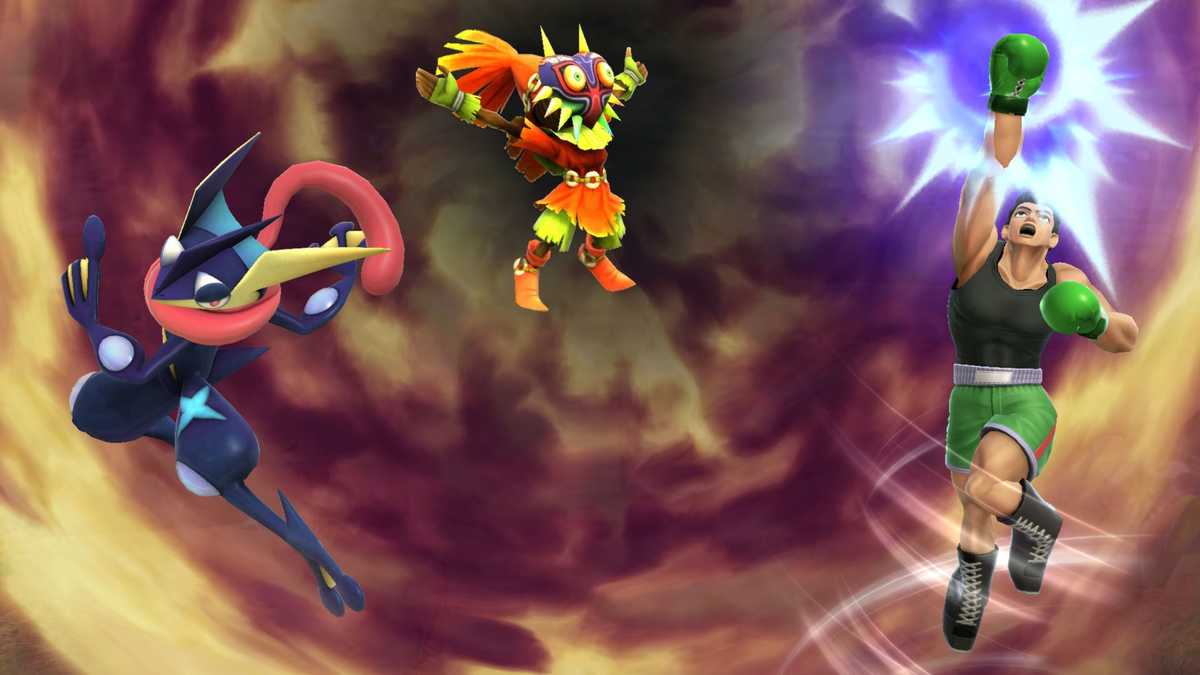
The Skull Kid from Majora's Mask is an assist trophy

Another way games are represented is through battle arenas, known as stages. Stages can also be very creative, such as how the Super Mario Galaxy stage features a planet with gravity that curves around the surface. The stage Pirate Ship, based on The Legend of Zelda: The Wind Waker, takes place on a ship sailing the sea, and it is occasionally fired upon, picked up by a tornado, and run aground on an island.

A smaller way of representing a series is through "assist trophies". Using this item will summon a randomly chosen non-playable character, like Jeff from EarthBound. Some more irritable fans don't like this, seeing it as an excuse not to make those characters playable, but I like how it lets them include characters they wouldn't have originally.

There are countless other ways references to Nintendo games can be seen in this game, but one of my favorites is the music, which I'll focus on in the next section.


Music

One of my personal favorite parts about Super Smash Bros is the enormous selection of music from past Nintendo games. Lots of games that are too minor to have a character or a stage still have pieces of music.

Each stage has a set of music, and one of the tracks is randomly selected at the beginning of each match. The player can set the frequency of each track, which is SUPER convenient for nerds like me who have very specific favorite songs.

Arrangements

While there is a great amount of music ripped straight from their original games, there is also a plethora of new arrangements of past songs for the game. 60 well-known video game composers worked on the arrangements in this game, including composers who worked on series like Final Fantasy, and Dark Souls. Of course, this also includes famous Nintendo composers like Koji Kondo, who created the original Mario theme and the Zelda theme.

Here are some of my favorite arrangements:


I just spent ten minutes combing through the tracks to pick those, which is a testament to the game's quantity and quality of music.

Competitive Scene

EVO, one of the biggest fighting game tournaments
Super Smash Bros for Wii U has a huge competitive scene. As I mentioned before, there are tournaments all over the world all year long. I, of course, am not a professional-level player, but I enjoy watching matches sometimes. The top level players are well known within the Nintendo community, and Nintendo themselves sometimes makes videos with them on their YouTube channel.

The Smash 4 competitive scene grew out of the Super Smash Bros Brawl competitive scene. But competitive Smash started out with Super Smash Bros Melee, the second Smash game, which came out in 2001. Melee is a much more technical competitive game, as the players usually use exploits that require immense technical skill. When Brawl came out, a much less technical game, the competitive community split. Many Melee players resented the game's simplicity, and stuck to Melee. So thus the Brawl community was formed, which became the Smash 4 community once that game was released.

Tuesday, March 7, 2017

Fire Emblem Awakening

Released: April 19, 2012 (JP), February 4, 2013 (USA)

Platform: Nintendo 3DS

Introduction

Fire Emblem Awakening is a strategy game released for the Nintendo 3DS. It is the 13th game in the Fire Emblem series, a series that made its debut in 1990, but didn't have any worldwide releases until the 7th game in the series.

The Fire Emblem games are strategy games, and the player must move characters around a battlefield, and the must take turns with the enemy team. Think of it like chess, if you were able to move all of your pieces each turn and if the chess board was much bigger.

Fire Emblem Awakening also has a big focus on characters and story. Each unit has their own personality and backstory. If a character dies in a level, they are dead for the rest of the game, which makes it pretty sad. Units can also build relationships through battle and have children, who can join your army.

Impressions

I got this game for my 15th birthday from a friend who had sung its praises, so I was really excited to play it. I had never played a game like it before, and at first I thought the gameplay was odd. As time went on, I quickly grew to love the gameplay however, and the game seemed very natural. I recently introduced the game to my friend (who is subscribed to this blog and I would recommend she skip the story section of this post). She also was thrown off by the gameplay at first, but she grew used to it more quickly than I did.

The game's characters and story really resonated with me. The game does a great job of intertwining the story and the gameplay, which is probably why. Overall, the game definitely has a "feel", and I enjoyed it so much that I am now on my 3rd playthrough.

Gameplay

The mechanics of Fire Emblem are simple on the surface, but there are a lot of details that should be learned in order to completely master the strategy. Thankfully, Awakening is a game that was made to introduce people to the series and its gameplay. I started out the game with a basic idea of the gameplay: on my turn I move my units, and if I move next to an enemy I battle it, lowering both of the units' health and hopefully killing the opposing one. But I began to see that there was a "rock paper scissors" mechanic with weapons, and I learned other things that made battling easier.

I also figured out the relationship system, which I think is an amazing way to tie the characters into the gameplay and build their personalities. When two units fight together on the battlefield, they raise their affinity, which will eventually raise their friendship level and let the player witness a conversation between them. These conversations, called "support conversations", are often funny and develop the characters' personalities.

Conversation between Maribelle and her son
Certain characters can also get married once they reach a high enough friendship level, and even have children. The children are all pre-defined characters, and they are always born to the same mother. Their hair color is the same as their father's, which depends on whom their mother marries. Through time-traveling shenanigans, the grown-up children can join your army and establish their own relationships with other characters.

Needless to say, I really enjoyed this part of the game, and I thought it was a great way to tie together the battles and the characters.

Music

Even though this game is on the 3DS, the music is pretty great in my opinion. Like I mentioned in the Majora's Mask and Super Mario Galaxy posts, Nintendo likes to do cool things with the music so it ties into the gameplay. In Fire Emblem Awakening, Each piece of battle music has two variants- the calmer, normal version and the more exciting "Ablaze" version. The calm version plays when the player is moving units around the battlefield, and it smoothly transitions into the Ablaze versions during battle animations.


Every standard piece of battle music has two versions, which really adds tension when the music grows more exciting during battles.

In general, the music has an orchestral style, with impressive quality for the 3DS. You can tell they're digital instruments, but not because they sound fake. One of my personal favorites is "Don't Speak Her Name", a sweeping song with story significance (it occurs after a tragedy).


Art

Fire Emblem Awakening has a few artstyles. The first, the style of the battle map, is sort of painting-styled. The units on the field have retro-styled sprites, which really pop against the muted colors of the background, especially when 3D is turned on:

Battle map
The most beautiful artsyle in the game is the style of the pre-rendered cutscenes. It's in an anime style, but it has a lot more depth and shading than most anime. I don't watch anime, but from what I've seen it seems to be a combination of anime and western 3D animation styles.

The effects are beautifully animated
There are around 10 cutscenes pre-rendered, but there are a whole bunch of other cutscenes in the game that use the characters' 3D models, in the same style as the battle animations. It doesn't look the nicest, but I like the character artwork and the hazy background. The characters can't convey as much emotion, but they can get the message across through the text and their body language.

Character art and the models in the background

Story/Characters (SPOILERS)

Fire Emblem Awakening has a story broken into two parts, with an overarching story as well.

Part 1: Plegia

The first half of the game is about the war between the kingdoms of Ylisse and Plegia. Gangrel, the king of Plegia, wants the war to happen, and tries to instigate one. Emmeryn, the exalt of Ylisse, however, doesn't want the war to happen. Emmeryn's father, the previous exalt, was very warlike and committed atrocities against Plegia, which is why Gangrel wants war and Emmeryn desperately wants to prevent it. Things escalate until Gangrel kidnaps Emmeryn, who tries to convince the Plegians that war is unnecessary. She proves to them that she isn't just saying this to save herself by jumping off a cliff after giving her anti-war speech.

I thought this was a pretty interesting first half of the game, and while it was a pretty weak start, the Emmeryn's sacrifice was a really great end to the first storyline.

Part 2: Valm

The second half of the game featured the story of Walhart the Conqueror's conquest, and his attack on Ylisse. The gang has to travel to the continent of Valm to defeat him. I felt like this story was sort of unnecessary, and I don't remember too much about it because the main story was more important.

Main Story

The main story follows Chrom, Emmeryn's brother, and Robin, the player's avator, as they try to gather the pieces of the Fire Emblem and prevent the rise of Grima, the Fell Dragon. This story kicks off as Lucina, Chrom's daughter, arrives from the future to prevent the Dragon's resurrection, as both her parents were killed in the battle with the dragon. At first taking the guise of a man named Marth, Lucina protects her father until ultimately revealing her identity.

Robin (the player's avatar) has no memory of his/her past. He/she follows Chrom as his tactician, until later in the game when Robin realized that the main antagonist is his/her father, and that he/she was bred to become the vessel for Grima.

I thought this was a pretty interesting story, but to me the journey of Lucina to assist and protect her father was more interesting than Robin's story.

*END SPOILERS*

Characters

A huge part of Fire Emblem is the characters. Each unit in Chrom's army has their own personality and relationships with the other characters, and those relationships can be strengthened through battle. The characters can have children, as I mentioned before, and I love the chemistry the characters have with their children.

One of my favorites is the relationship between the dark mage Tharja and her daughter Noire. Tharja has a very sinister, sadistic, stalker-like personality (comparable to April Ludgate from Parks and Recreation). Her daughter Noire is cripplingly shy, and is easily intimidated by her mother, who practices spells on her. Noire has kept her mother's wedding ring as a talisman, and taps into a confident, raging personality when she wears it.

Tharja doesn't want her daughter to rely on a talisman for confidence, so she finds ways to help Noire tap into that part of herself without the ring, which shows a subtle mothering side of Tharja that usually isn't seen. Lots of character interactions are like this, and it gives the game more depth.

Context

Fire Emblem Awakening was an unexpected success. It was also a much needed success. With the exception of one or two games that sold respectably, the Fire Emblem series had never sold very well, especially outside of Japan. Awakening was Intelligent Systems' (a subsidiary of Nintendo that makes Fire Emblem) last chance to justify new games in the series. When it was released, Awakening sold gangbusters, and introduced many new fans to the series. Since then, another entry in the series (Fire Emblem Fates) has been released, and another is slated to release this April and yet another in 2018. This game singlehandedly revitalized the series, and introduced many fans, including me, to it.