In this blog I reflect on individual video games I have played over the years (mostly Nintendo games, 'cause that's what I play). I try to introduce the game to people who haven't played it before, and to give my feelings on the game so people who are familiar with it can see my perspective.
I'll also talk about the history of the games and any insight the developers have given on the process behind creating them.
Showing posts with label Action/Adventure. Show all posts
Showing posts with label Action/Adventure. Show all posts
Breath of the Wild has a surprisingly low amount of music compared to other Zelda games. Most of the time, when Link is traversing the overworld, there isn't any music aside for the occasional few piano notes.
That being said, this game does have its share of great songs, just a significantly smaller share than other Zelda games. This isn't because the songs aren't good, of course, it's just because there aren't very many. One which stands out to me is the Hyrule Castle theme, a sweeping, epic song that is befitting of the game's final battle, and that pulls from the series' many past themes.
Most of the soundtrack, however, consists of background piano music, which consists of flourishes and the occasional simple melody. This is what plays when roaming the vast fields of Hyrule, most of the game's world, and it captures the game's atmosphere in a way I can only describe as masterful.
Some have bemoaned the lack of more traditional songs, as past Zelda games have had. But the primary function of music in a game is to complement that game, not necessarily to provide a soundtrack that can stand on its own (although this is definitely not uncommon).
Manaka Kataoka, one of the two primary composers, had never worked on a game of this scale, and was known as the composer for Animal Crossing games (a Nintendo series about managing a town of animal residents). But her music in this game has fit perfectly with what the game was trying to capture. She also composed the theme for one of the first trailers, a theme that left many fans in awe as they watched for the first time.
(I meant to finish this post last year but never did, so I thought I might as well publish it)
Guys. This is an amazing game. I feel like this is one of those landmark games, like Super Mario Bros, LOZ: Ocarina of Time, and Final Fantasy VII. I'm serious. But only time will tell.
If you've never played a Zelda game before this one, fear not. If you haven't played many video games before this one, fear not. Because even though this game can be hard at times, it isn't the kind of hard that requires technical skill, it's the kind of hard that requires you to think critically, and everyone (most people) can do that.
Part 1? What are you trying to pull?
Sorry, but there's so much I have to say about this game that squeezing it into a single post would be unpleasant for everyone. There will be a second one soon, and at the bottom of this post you can see exactly what it will cover. I'm going to split some categories over both parts.
In past Zelda games, there were specific methods of getting to different places and solving certain puzzles. In Ocarina of Time, to get to the Gerudo Desert, you had to use the hookshot to breach Gerudo Valley. The world had walls everywhere, and you could only approach most locations from one direction. In Breath of the Wild, however, the map is seamless, and you can approach every location from all directions. To get to Kakariko Village, you could certainly take the path that leads to the gate of the village, but you can also walk up the field to the west to find another path, or even go around and climb up the mountains from the north to drop down on the houses.
Link floats upwards after setting grass on fire
Many methods of getting around the world involve the natural mechanics Breath of the Wild introduces. Simple things, like cutting down a tree to cross a chasm, or using the paraglider to catch an updraft from some burning brush, can help Link reach new places. In this way, the game is very friendly to inexperienced gamers. Simple problem solving skills are the only thing required to reach one of many solutions to each of the game's puzzles.
Shrines/Dungeons
From my Majora's Mask and Wind Waker posts, you may be familiar with the focus of dungeons in the Zelda series. If not, just know that dungeons are elaborate labyrinths with a sequence of puzzles and enemy fights, culminating in a boss fight at the end.
In BOTW, there are only four dungeons. Each one takes place in a "Divine Beast", one of four animal-shaped mechanical creatures intended to protect Hyrule from Ganon. Compared to dungeons in other games, they're pretty simplistic. I wish they were more like dungeons in other games, but I can see that the developers chose to focus on the overworld.
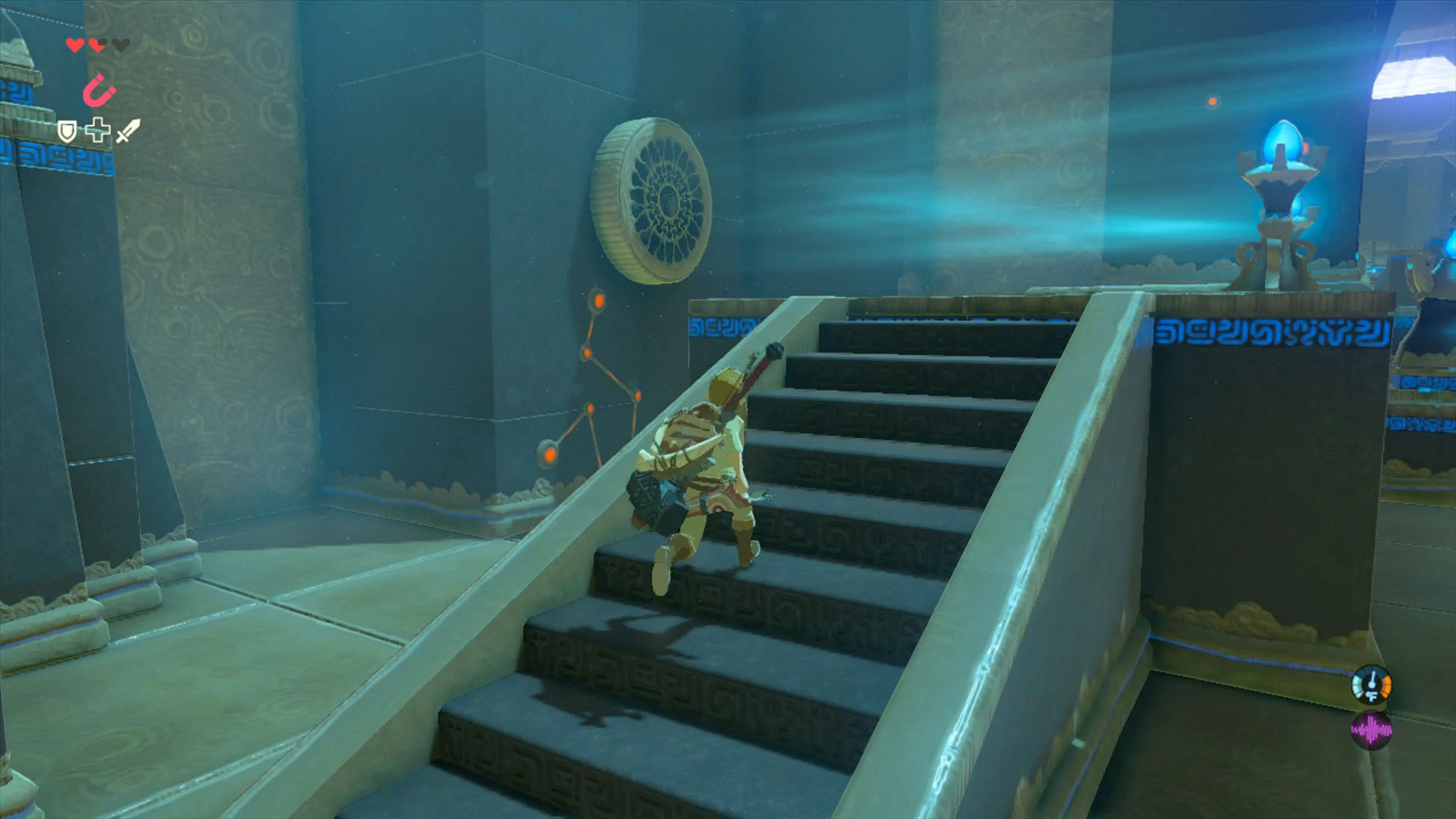
A wind puzzle in a shrine
To make up for the lack of dungeons, there are 120 'shrines' scattered all over the world. These are sort of like dungeons, but are very short, focusing on one concept for a puzzle. Some are very short, with just one puzzle, and others can be longer, with 5 or 6. I actually liked the concept of shrines, because the puzzles were always very unique and creative, and required some real thinking. In some other Zelda games, dungeon puzzles often were as simple as sliding block puzzles, so this was welcome.
Abilities
At the beginning of the game, Link gains a few core abilities that are used all throughout the game, from traversing the world to aiding in combat to solving puzzles in shrines. Remote Bombs are energy blasts which Link can detonate from a distance. Magnesis lets him manipulate metal objects through the air. Stasis locks an item in place for a short time. During this time, one thing Link can do is hit the object repeatedly to build up force, causing the object to experience the combined force once Stasis runs out. Cryonis makes a pillar of ice rise from a body of water, which can lift up gates, help Link traverse water, etc.
I love the abilities because using them in tandem creates some really interesting puzzles, combat methods, and even exploits.
Story/Characters (champions)
In Breath of the Wild, Link wakes up in a preservation chamber 100 years after a great calamity struck Hyrule. During that calamity, there were four "champions" who helped Link and Zelda (try to) defeat Ganon. They died in the struggle, but through memories and ghostly apparitions, the player gets to know each of the four champions. They're strong characters, in my opinion.
Mipha
Mipha is a member of the sea-dwelling Zora race, and she had a crush on Link since their childhood together. She is quiet and shy, but she shows resilience in the face of danger. I like how she is dedicated to helping Zelda even though she knows Link has feelings for Zelda. Mipha is said to be quite handy with a spear, and she pilots the elephant divine beast Vah Ruta. I'm not a huge fan of her voice actor, though.
Revali
Revali is a Rito, a race of bird people. He's arrogant, but lovable at the same time. He resents Link for being the Hero of Legend, believing himself to be more skilled than Link is. When Link meets Revali's spirit after completing the dungeon in Revali's Divine Beast, he finally acknowledges Link's skill. Revali's confidence makes him memorable, and I actually like his voice actor.
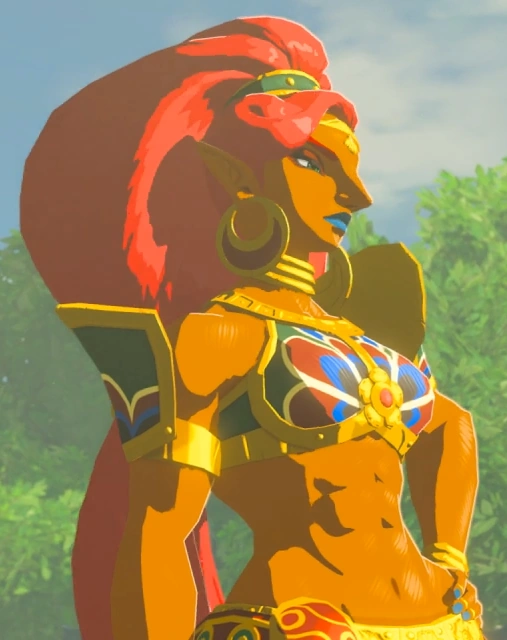
Urbosa
Urbosa is the chief of the Gerudo, a race of women living in the desert. She is seen acting like a big sister to Zelda, and she has some pretty kick-ass lightning powers. In the group of champions, she seems to be the wisest, and the one who maintains order. She also has a surprising hunger for revenge against Ganon, and she relishes the chance to help in defeating him.
Daruk
Daruk is a Goron, a rock creature who lives near the volcano. He's the least developed character, but from flashbacks it can be seen that he acts like a big brother toward Link. There's also a touching scene where Daruk's descendant sees his spirit. The excitement and sadness are almost tangible in the young Goron's expression.
Art
This game uses a cell-shaded graphical style, which I think suits it very well. It looks a lot like Studio Ghibli films, and its style was inspired by traditional Japanese animation.
Ahhhhh
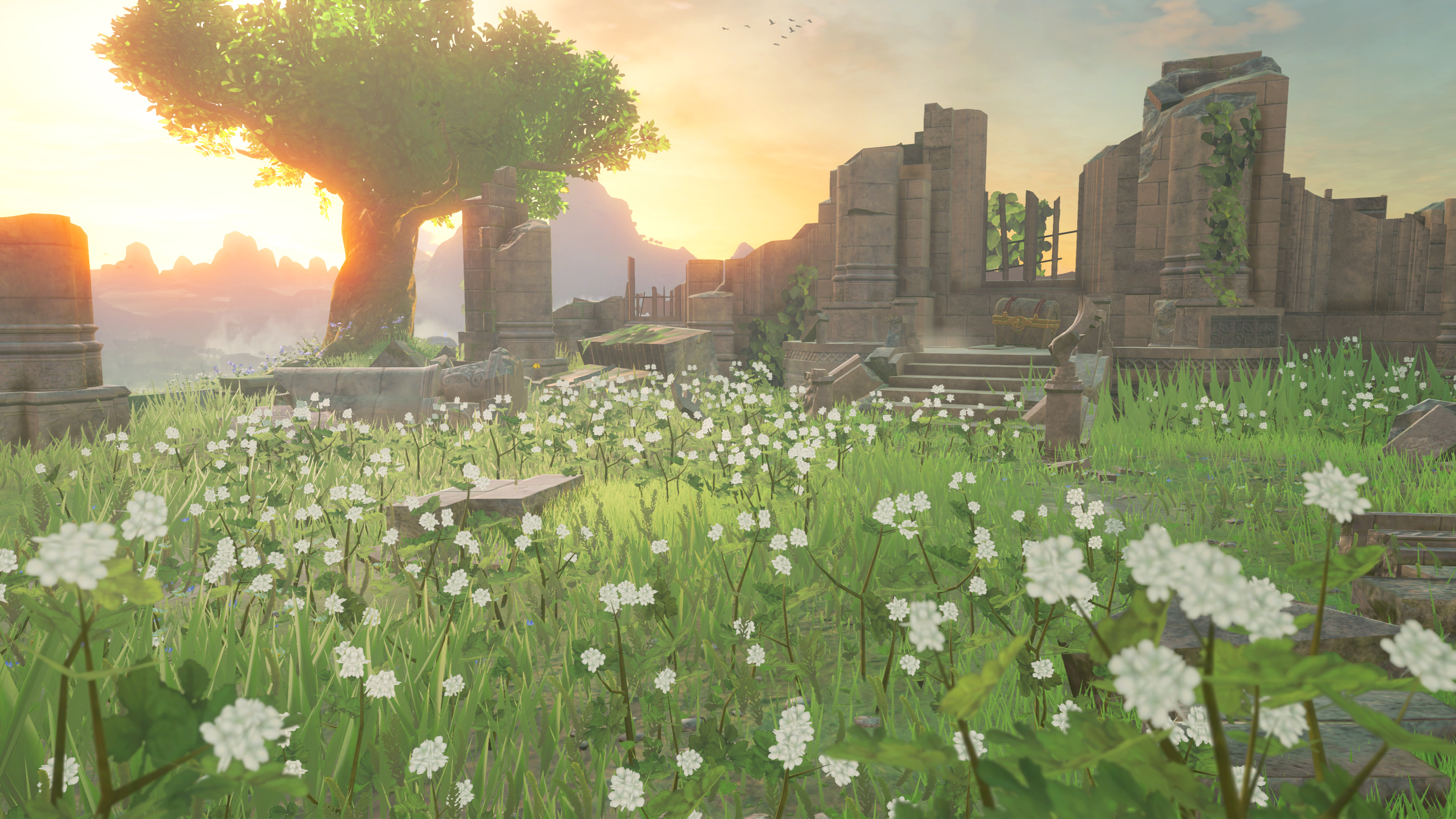
The open world of Breath of the Wild combined with the artstyle make screenshots of this game look like paintings. Any shortcomings in the Nintendo Switch's graphical capabilities are masked by the style.
Be still, my heart
The characters also benefit from the style. The features in their faces are more pronounced, making them more expressive and letting the developers convey emotions with subtleties in the faces.
Part 2
Part two will include Gameplay (combat, food, and quests), Music, and Characters/Story (Zelda and Link). I hope to have it out in a week.
Paper Mario: The Thousand Year Door is the 2004 sequel to the 2001 Paper Mario. Unlike later games in the series, it keeps the same core gameplay as the original game. Most Paper Mario fans say this is their favorite game in the series because of how well it expands on the first game.
I recommend you read the gameplay section my post on the first Paper Mario game, just to get the gist of it. You'll want to know what partners are, and how the battle system works. Without further ado, let's begin.
Gameplay
The first game, while using paper as a unique artsyle, didn't really do much with the paper theme when it came to gameplay. But in this game, Mario gets different paper abilities, like folding into an airplane, that enhance the game. My favorite is his ability to turn sideways to squeeze through cracks, a simple yet ingenious idea that allows for clever puzzles. After he gets this ability, Mario can slip between buildings, down a sewer grate, and through jail bars.
The abilities the partner characters give you are interesting as well. For example, Flurrie blows air that "blows away" pieces of the environment to reveal secrets and hidden areas.
The overworld is laid out much like the first Paper Mario game: different sections of the world all connect to a central hub town. In this game, it's Rogueport: a grungy port town with shady characters and a conflict between two gangs. Rogueport was, in my opinion, a fresh departure from the traditional cutesy locations Mario games are known for.
Battle
The Thousand Year Door returns with a very similar battle style to that of the first game. Mario still takes turn attacking the enemy, with the assistance of one partner at a time, and having the enemy take a turn attacking him. In this game, however, the battles have more complexity and strategy. The partner character now have their own health meters, and can swap positions with Mario if he is low on health.
In addition to timing a tap of the "A" button to reduce the damage from enemy attacks, pressing the "B" button negates all damage and does damage to the enemy, albeit requiring much harder timing.
Music
I'm conflicted about this game's music. I find some of the instruments used to be kind of annoying, but there are some really good themes. Here is one that I liked regardless of the instruments:
The theme is from the game's opening, and I love it because of how mysterious it sounds. It plays while the story of the ancient city beneath Rogueport is being told.
Some music was more atmospheric than melodic, which I usually liked. Here's Boggly Woods, which really goes with the area's look of the black and white trees and the shimmering ground:
Boggly Woods
Characters/Some Story
Like the first game, the story is a pretty simple one, if a little less like other Mario games. That's not necessarily a bad thing, however. The story that is there is heartwarming, memorable to many Nintendo fans, and leaves the player feeling satisfied. The characters really shine, though, and the simple story puts them in the spotlight. The Thousand Year Door is the most popular Paper Mario game because of its characters, which should be no surprise.
Partners
Like the first game, TTYD has partners that join Mario on his quest as the game progresses. The main partner, while still a goomba, is much more interesting than Goombario from the first game. Her name is Goombella, and she is an archeology student studying under Professor Frankly at the University of Goom (gooo goombas!). Her spunky commentary on enemies and areas makes the game more interesting.
Madame Flurrie (the one with the...shapely body) is a retired movie star longing to return to the stage. She's also a wind spirit, somehow? Flurrie is great, though, yet another interesting character.
Admiral Bobbery is an old sea captain who never forgave himself after his wife died while he was at sea. His story is one of the more emotional parts of the game, and I had a reaction to it similar to my reaction to Rosalina's Storybook in Super Mario Galaxy.
Vivian is originally an enemy, a member of the Shadow Sirens. But she is emotionally abused by her sisters, and ends up joining Mario's side after he treats her with kindness. In battle she uses cool fire attacks, so thats a plus too.
Princess Peach and the Shadow Queen
**minor spoilers**
Princess Peach, normally a passive character in the Mario Series, has a surprisingly defined personality in this game. She does still get kidnapped, but in the game's intermissions the player can once again control her as she sneaks around. In TTYD, the princess is kidnapped by an alien clan known as the X-Nauts, and she sneaks around the X-Nauts' lunar base to email information to Mario.
Peach and TEC-XX
The princess's stories, which took place between the chapters, I found to be surprisingly entertaining. The main plot revolves around Peach befriending the base's main computer, TEC-XX (based on HAL from the movie 2001: A Space Odyssey). She teaches the computer about the concept of love in exchange for security clearance as she sneaks around the base. In one surprisingly risqué scene, Peach has to strip down naked after TEC made her invisible. Being invisible, she obviously didn't show anything, but it's not something you usually expect from a Mario game.
Ultimately, Peach makes a strong connection with TEC and gets him to betray the X-Nauts. I loved it when this story converged with the main story, but I always love when storylines converge, so idk if that's a plus.
**major spoilers to a 2004 game, you have been warned**
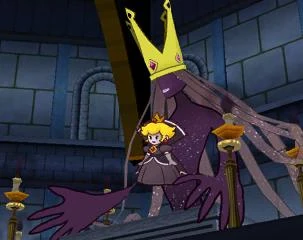
In the final scenes of the game, the leader of the X-Nauts lets loose the Shadow Queen, a demon who was trapped in the ancient city beneath Rogueport. The Shadow Queen uses Peach as a vessel, and possesses her body for an amazing final boss battle against Mario and his partners. There's a scene where all the candles in the room go out, and then are lit with black fire one by one, which was a deliciously creepy touch.
The Shadow Queen, the Peach storyline, and the setting of Rogueport all give The Thousand Year Door its unique personality. It's edgier than most, if not all other Mario games, but it doesn't take itself too seriously so it doesn't get into the "cringy" territory (see: Shadow the Hedgehog)
Playing this Game
Can I play this game?
To play this game legitimately, you need a GameCube or a Nintendo Wii system. You're more likely to have a Wii, which can play GameCube games thanks to backwards compatibility. You also need a GameCube Controller and a memory card, both of which are pretty inexpensive, especially if they're used.
Should I play this game?
Paper Mario: The Thousand Year Door is a great game for non-gamers, in my opinion. The game requires little technical skill, and like many Nintendo games is designed with new gamers in mind. The lighthearted plot and memorable characters will make this game stand out to even the most skeptical.
If you ARE a Nintendo gamer and haven't played this, game, what are you waiting for? This game needs to be played YESTERDAY!
Original Release: December 13, 2002 (JP), March 24, 2003 (USA)
HD Release: September 20, 2013
Platform: Nintendo GameCube (original), Wii U (HD)
Introduction
The Legend of Zelda: The Wind Waker was originally released on the Nintendo GameCube in 2002, but the version I have played is the HD remaster, released for the Wii U in 2013. I'll talk about the differences at certain points, but there aren't any major changes other than the graphical overhaul and a few gameplay changes that make the game more enjoyable.
Gameplay
Wind Waker was the third 3D Zelda game ever made, and the 2nd if you don't count Majora's Mask because that game was weird (and amazing), and used the same engine as Ocarina of Time. But this was Nintendo's first real attempt at a 3D Zelda after the universally acclaimed Ocarina of Time, so they wanted to do something different. And they did.
Sailing from island to island
Sailing
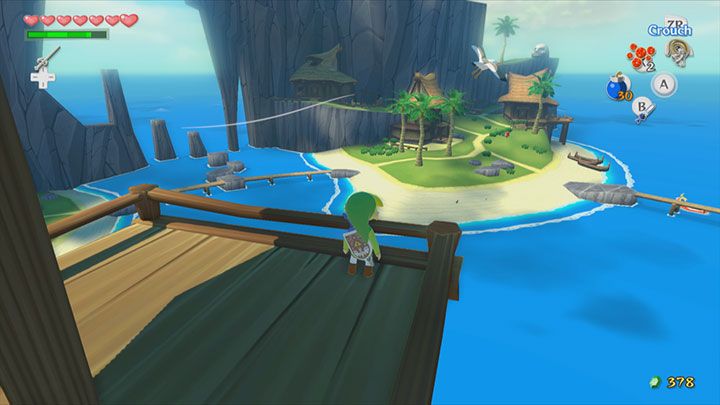
While most Zelda games, especially the 3D ones, take place in the sprawling kingdom of Hyrule and its varied terrain, this game takes place on an ocean, the Great Sea. Instead of using a horse to ride from place to place across Hyrule Field, Link uses a sailboat and manipulates the winds to sail from island to island. This was a common complaint of the original Wind Waker, because whenever the player wanted to change the direction they were sailing they had to play a song. They fixed this in the HD version by adding the Swift Sail, an item that lets you sail twice as fast and changes the wind direction automatically.
Battle
I love the battling in this game. It's probably my favorite battling mechanics in any Zelda game (except Breath of the Wild, which I hope to cover soon, see the bottom notes). In Ocarina of Time, this game's direct predecessor, battling was usually just two identical sword swipes and then a swipe in the opposite direction. I'm simplifying it a bit, but that's pretty much how Link attacked. In Wind Waker, it's much more lively, with Link doing spins, jumps and dances between his sword thrusts, and with orchestra hits whenever he landed a hit on an enemy.
Gripes
The Triforce Quest, the part of the game where you must gather the 8 pieces of the Triforce of Courage scattered all over the Great Sea, is known to be an annoying part of the game. I agree with the popular opinion that this quest is drawn-out, unnecessary, and stops the flow of the game. They made it significantly easier in the HD version, but it's still an unwelcome quest.
Music
Here are a few music pieces that I feel encompass the Wind Waker. I'm using the soundtrack of the HD version because the audio is better quality, but the songs are almost identical.
The Great Sea
This song plays whenever Link travels on the ocean, which is a large part of the game. Because of this, this song is very iconic. It gives the feeling of setting off to sea on a grand adventure. It starts out with a hint of the famous Zelda theme, but quickly develops into its own melody. There's also a wonderful remix in Super Smash Bros.
This song also changes with gameplay, which Nintendo seems to like to do. When it's stormy out, it transitioned into an ominous rendition of the song, and during sunrise and sunset, it's a laidback, peaceful version.
Molgera
*chikka-chikka-chikka-chikka*
^Original version^
^Version in Wind Waker HD^
"Molgera" is a song that plays when fighting the Molgera, a giant sand worm. Wind Waker was different from past Zelda games because each boss has its own battle theme. In past games, all the bosses shared one or two music themes. When bosses like Molgera have their own themes, it really makes the battle more unique and memorable.
Selfie with the Molgera
This song uses a lot of percussion, which really helps give it a 'desert' feel. The melody, on a flute/tin
whistle-like instrument, cuts through the background percussion for a really cool sound. As you may have noticed, I put both the original version and the HD version up there. This is because they changed some things in the HD version that sort of change how the song feels. I really can't decide which one I like more, but they definitely have a slightly different feel.
Also, check out this rock version from Hyrule Warriors Legends if you want something spicy.
Artstyle
When Wind Waker was released, it got a lot of crap for its "cartoony" artstyle. Fans were expecting a more realistic Zelda game, in line with Ocarina of Time. Over time, however, Wind Waker's timeless style is almost universally acclaimed.
While Ocarina of Time (and Majora's Mask) have aged pretty badly over the years, the original version of Wind Waker still looks stunning because of its cel-shaded artstyle. When The Wind Waker HD was announced, many fans said that there was no reason for an HD rerelease because the original still looked so good. I agree, and I think this is the best Zelda artstyle (besides possible Breath of the Wild).
Story/Characters
Premise
This game takes place hundreds of years after Ocarina of Time. When Link went back in time to his own time at the end of OoT, he left Hyrule without a hero. Because of this, Ganondorf returned, and the three goddesses flooded the kingdom of Hyrule after telling the citizens to go to the mountaintops.
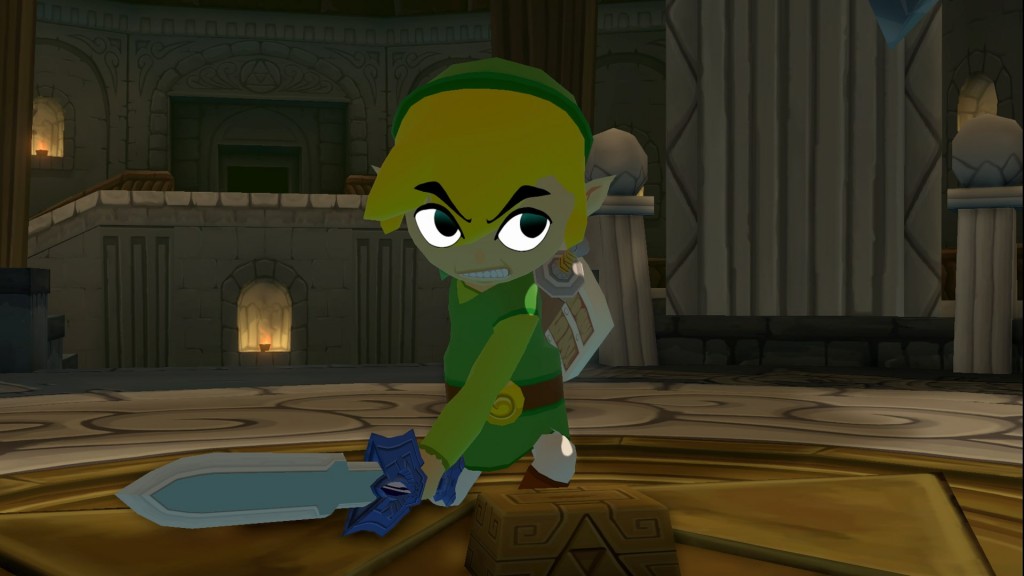
The Great Sea, in Wind Waker, is the ocean that covers the old kingdom of Hyrule. The islands are the mountaintops, and the people are descendants of the old citizens. At one point in the game, you actually go beneath the sea to the old Hyrule Castle, where there's a statue of Link from Ocarina of Time, and stained glass windows depicting each of the Six Sages of the same game. The castle has been preserved in a bubble of air, and the King of Hyrule has been waiting there since the flood.
Link's goal is to defeat Ganondorf, who resides in his tower under the ocean, and flood the rest of the kingdom so Ganondorf is sealed under the ocean forever.
Characters
Link, you monster!
Wind Waker is one of the few Zelda games were Link has a family. He lives with his grandmother and sister on Outset Island. When his sister is taken away, he has to leave the island to rescue her, leaving his grandmother all alone. As he's setting sail with Tetra and her pirate crew, the player sees the grandmother sadly waving from her house as the ship leaves, which really tugged on the ol' heartstrings.
**Well known spoiler, but just to be safe**
Right after the ship leaves, Link keeps waving goodbye to his grandmother from the bow of the ship. Tetra, the leader of the pirates, makes fun of him for being homesick already, and says he won't last long on the ship.
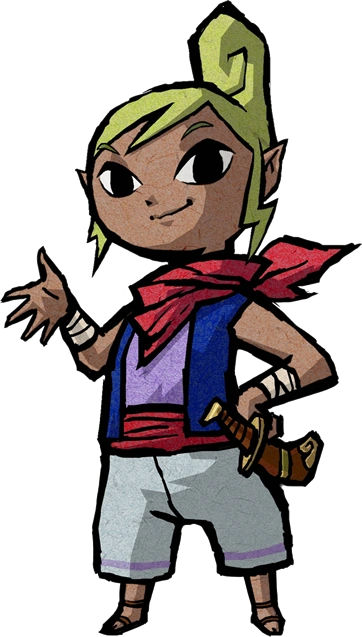
Tetra is one of the more interesting versions of Princess Zelda, and definitely more interesting than all of the Zeldas before Wind Waker came out. She's the leader of a pirate crew, and sails the Great Sea, pillaging the islands. The only reason she let Link come on their ship was because she was guilt-tripped about his sister. Once it is revealed to Tetra that she's Zelda, she unfortunately takes a much smaller role in the story.
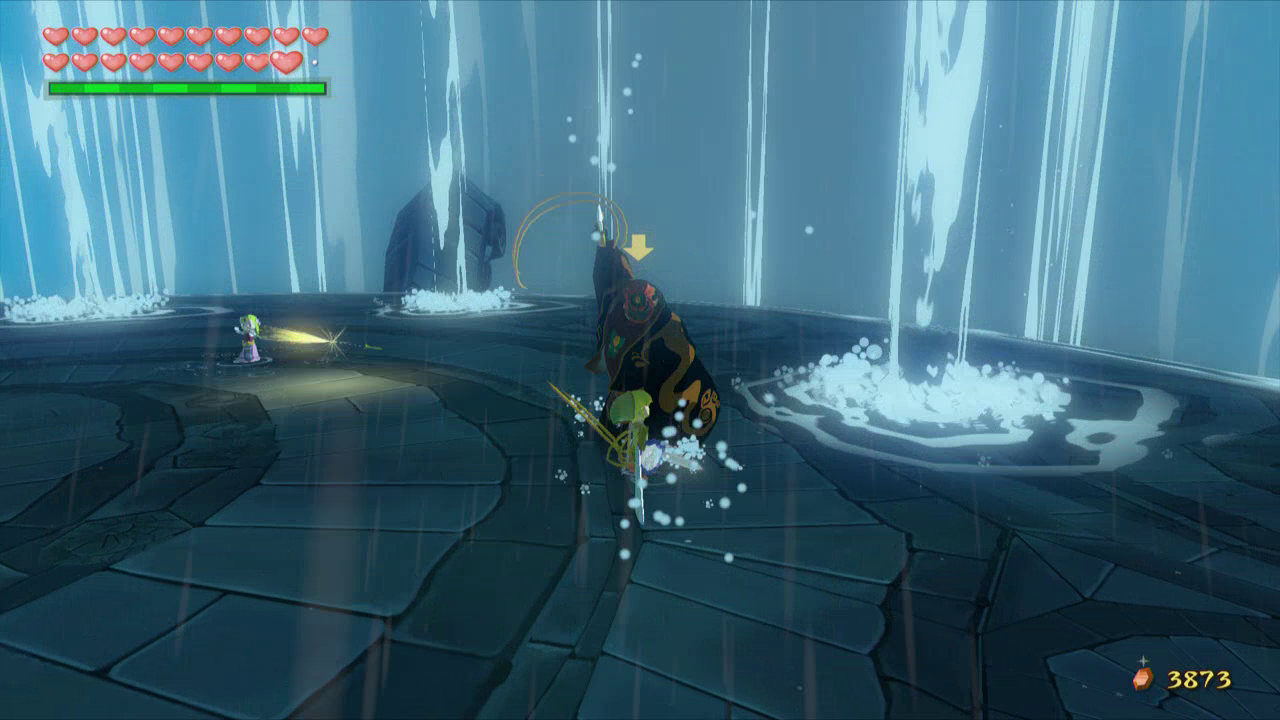
She does join in on the final battle with Ganondorf, however. She and Link fight Ganondorf on the top of his tower as the rest of Hyrule is being flooded. Zelda uses her bow to shoot Ganondorf with light arrows, at which point Link must strike him with his sword. It was an amazing final boss, standing out in a series that usually has great final bosses.
Notes/BREATH OF THE WILD!
You may have noticed (probably not) that I added The Legend of Zelda: Breath of the Wild to my "posts sometime in the future" section. This is kind of different from the other posts in that section, because a) I have not finished the game yet, and b) it is a VERY recent game (March 3, 2017). Because of the general hype and praise around BOTW, I'm going to do a post about it right when I finish it. I'm going to have to bump down the posts in the Upcoming Posts list, but alas, I don't care.
The Legend of Zelda: Majora's Mask is a game in the Legend of Zelda series. If you're unfamiliar
with the Zelda series, they are a series of action-adventure games in a fantasy setting, featuring an overworld and dungeons that revolve around puzzle solving.
Majora's Mask is known for being different from most Zelda games for a variety of reasons, even though it uses the same engine and many of the same assets as Ocarina of Time. Majora's Mask doesn't take place in the kingdom of Hyrule, as most games do, but in an alternate-reality world called Termina. When Link (the main character) arrives in Termina, he learns that the moon is falling, and that Termina will be destroyed in three days. The game features a 3-day cycle, and is constantly counting down to when the moon crushes Termina. At any point in this cycle, Link can play a song to time travel back to the first day, but by doing so he loses everything he obtained during that cycle except for the key items.
The game revolves around this concept. Link starts at the beginning of the first day, makes some progress that can remain after the cycle resets, and resets the cycle before he is killed by the moon. When he goes back in time, everyone he has met forgets who he is, which makes the game feel pretty lonely.
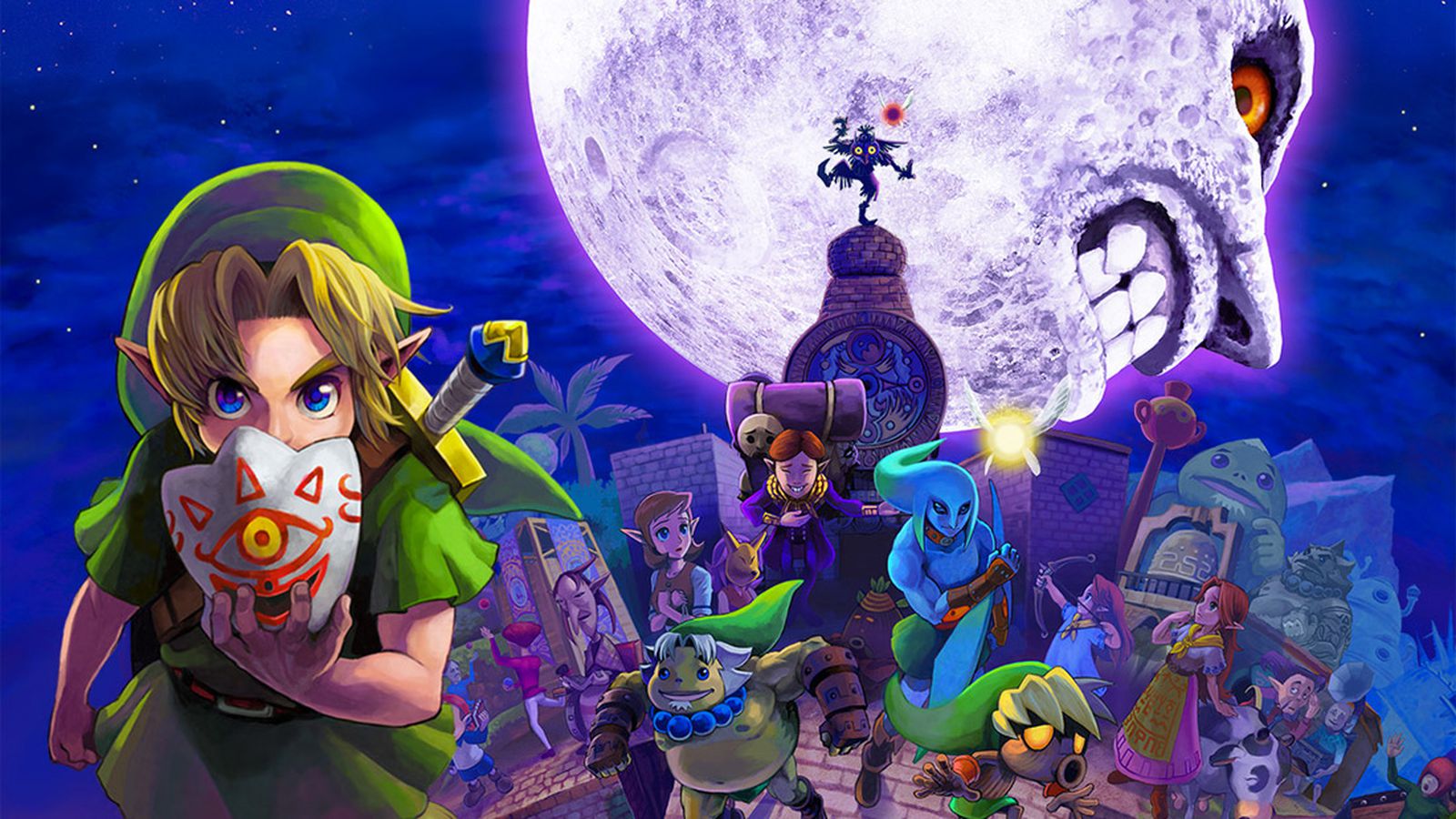
Official art for the game's 2015 remake on the 3DS
Because of this, the game has a constant foreboding, oppressive atmosphere that sets it apart from the other Zelda games, none of which are as dark as Majora's Mask is. Without further ado, let's begin!
Gameplay
Like I said before, Majora's Mask uses the same game engine as The Legend of Zelda: Ocarina of Time. OoT is commonly cited to be the greatest game ever made, so you know that both games have excellent gameplay. The 3 day countdown, the thing that really sets Majora's Mask apart from Ocarina of Time, can be bothersome at points, but I give it a pass because it contributes so much to the game's atmosphere and sense of "doom".
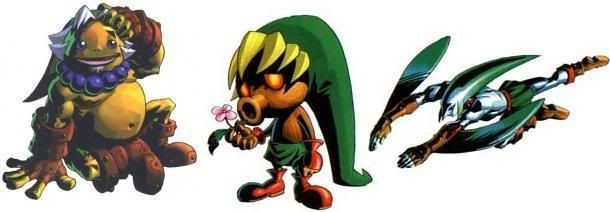
The three transformations
Like Ocarina of Time, the game revolves around Link completing dungeons to continue the story, and getting important items from the dungeons that let him access other places in the world (For people unfamiliar with dungeons in video games, they are usually large labyrinths with puzzles to solve and enemies to battle).
Another new aspect of Majora's Mask is the transformation masks, which let Link take 3 alternate forms, each with their own abilities and puzzle-solving use. Keeping with the game's theme, each mask is obtained after the character the mask is based on dies. The form Link takes is supposed to use the 'soul' of the recently deceased character.
The central gimmick of the Great Bay Temple
There are only four real dungeons in Majora's Mask, as opposed to the 9 dungeons of Ocarina of Time. And to be honest, the dungeons in this game aren't the best. The one I really enjoyed was the Great Bay Temple, which seems to be an unpopular opinion. I loved the dungeon's main mechanic, which involved changing the flow direction of the water being pumped throughout the dungeon. The flow direction changes which underwater rooms Link can access, and I thought it was a pretty unique idea. The fan-favorite dungeon from this game is the Stone Tower Temple, which I didn't enjoy as much as everyone else seems to. The gimmick of this dungeon is that you have to keep flipping the dungeon upside down and rightside up in order to progress, which I'll admit is pretty cool and novel.
Music
Staying with the game's theme, there is a lot of music that is either creepy, unsettling, sad, or all three. The most famous song from this game is almost certainly the Song of Healing, so please take a listen:
This song, despite its title, has a melancholy feel to it. The dichotomy of the happy title and sad-sounding music can also be found in the situations where the song is played. For example, Link must play the song to a character who is passing away in order to rest their spirit. The moment is sad because the character is dying, but happy because the song makes them at peace.
Nintendo loves to use variations on a central theme in their music. The four main areas of Majora's Mask use different versions of the same unsettling melody to fit the environment. These are the four songs:
Another cool music trick Nintendo uses is shown in the music of Clock Town. This (subtly named) town is the central hub of the game, and is where most of the characters can be found. The town's clock tower is also where the moon crashes into if Link doesn't go back to the first day in time. The town has a very distinct melody, but the music changes depending on the day. The first day, the theme is very laidback. On the second day the theme uses different instruments and includes fast moving patterns to make it sound slightly frantic. On the third and final day, the song is very quick, and you can hear ominous, minor undertones that clash with the melody, signaling the end is near.
Here is the theme for each of the days. I would suggest starting at 0:18 for the first one.
Art
SMEARY WALLS AND FLOOR
The art direction is not this game's strong point, especially if you're considering only the original version. I think the 3DS remake makes it look a lot more bearable. But the fact is that Majora's Mask uses a lot of the same assets as Zelda: Ocarina of Time, a game created when Nintendo was still learning how to make 3D games look good. The Nintendo 64 couldn't render a lot of polygons at once, making a lot of models pretty chunky. That would be ok if the textures were nice, but like most N64 games, textures tend to be "smeared" across surfaces.
I haven't played the 3DS remake, but from what I've seen, the models have a lot more polygons and the textures look a lot better. If you care about how your games look, definitely pick up the 3DS version if you can. Here's an example of the improvement, with the original on the right and the 3DS remake on the left:
Story/Characters
This is where Majora's Mask stands out, especially among Zelda games. While the plotline isn't especially complicated, the game does a great job of making the fantastical story pretty believable.
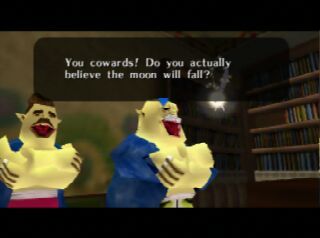
As you know, the game is about the moon falling into the land of Termina, and Link's time-traveling journey to stop it. In the main town of Clock Town, people seem to be getting worried as time goes on, but there are also lots of people who are in vicious denial that they will die in 3 days. Even though the moon can be seen growing closer and closer, some people laugh it off and continue preparing for the Festival of Time, which is supposed to take place on the 4th day, after the moon hits. This particular tidbit has some eerie parallels to the real world, where people deny climate change in a similar fashion, which makes the story that much more believable.
Denial can be found many places in Clock Town, but the other parts of the world all seem to react differently. In fact, a popular fan theory is that each of the world's five areas represent the 'five stages of grief': denial, anger, bargaining, depression, and acceptance. This is very well discussed in the popular video by Game Theory theorizing that Link is actually dead during the events of Majora's Mask. I highly recommend it if you haven't seen it.
Other than the main moon plot, there are several smaller plots and character developments that flesh out the game. The most famous one is the Anju and Kafei quest, following the events of two lovers trying to get married. However, the Skull Kid, the game's antagonist, turns Kafei into a small child, who then runs away in shame. Link must help Anju find her transformed fiance, and the quest ends with the two marrying themselves in a room in Anju's inn, and cowering together in the last few minutes before the moon hits the town and kills them.
The main antagonist, the Skull Kid, also has a story if you look hard enough. Before he stole the Majora's Mask and became consumed by its power, he was a lonely woodland creature who wanted to play with the fairies. Various moments make the player pity him, which I thought made him a good antagonist.
Some other great characters are Cremia, the young woman who runs the ranch, and her little sister, Romani. Romani is pretty young, under 10 years old, so Cremia acts as a mother to her. On the night before the moon falls, Cremia knows what's going to happen, so she lets Romani drink Chateau Romani, the game's milk equivalent to alcohol. She also says they'll sleep in her bed that night, knowing that they would die before morning. Little stories like this really make the story and characters seem more real.
Context/Impact
As I've said before, Majora's Mask was created using the assets from a previous Zelda game, Ocarina of Time. It was also the first game that Eiji Aonuma produced, and he has produced all the Zelda games since. Aonuma was given less than a year to create Majora's Mask, which was a challenge from Shigeru Miyamoto (creator of Mario, Zelda, Wii Sports, etc.). This is why so many assets were reused from Ocarina of Time.
Majora's Mask
People were skeptical about a game created in such little time. They thought it would be too similar to Ocarina of Time, and would be an underdeveloped mess. But most agree that this is not what happened, as Aonuma managed to make a game with an entirely different atmosphere and unique game mechanics that set it apart from OoT.
Ocarina of Time
Notes
I'm really excited for Fire Emblem Awakening, and I will certainly have a lot to say about it. With Majora's Mask I didn't have as much to say about the gameplay, and practically nothing to say about art, but with FEA I expect to talk about all the aspects because the game is amazing in so many ways.
Metroid Prime is a first person adventure/shooter game released in 2002 for the Nintendo GameCube.
While it is technically a shooter, the game focuses more on exploration than combat. It was universally praised by critics upon release, and is the highest rated first person shooter of all time according to Metacritic.
The game stars a scientist and bounty hunter by the name of Samus Aran, and you play as her after she lands on a planet known as Tallon IV. The game revolves around finding upgrades to Samus' suit and eradicating the substance known as 'phazon'.
Impressions
I'm not a huge fan of shooter games, but Metroid Prime is definitely an exception. Part of that was probably the focus on exploration and puzzle-solving, which you do across the whole game world. The world was another major factor in my enjoyment of the game. Tallon IV, the game world, is an interconnected set of five areas, each with a distinct atmosphere. When I took an elevator up from the lava-filled caves of Magmoor Caverns into the snowy Phendrana Drifts, I was in awe. I think the world, and using Samus's suit upgrades to traverse it, is what makes this game great, and the amazing atmosphere is what makes it stand out to me.
Gameplay
When you play as Samus, you use her arm cannon to defend against aliens, open doors, and solve puzzles. The game starts you out with a very limited set of abilities, but as you progress you find upgrades to your moves that let you access new areas. Some of these include Space Jump, which lets you jump in midair, the Grapple Beam, which lets you swing across gaps, and my personal favorite, the Wavebuster, which sends out a Ghostbusters-style stream of electricity from your arm cannon that leeches the life of the monsters you attack.
The Wavebuster being used in a peaceful waterfall area
The game uses these upgrades very cleverly, however. For example, early on in the game, I saw a ledge too high to reach with my abilities at the time. But later, after I got the Space Jump, I remembered the place I came across before and I was eager to go back with my new upgrade to explore more of the previous area. In fact, the whole game is based around this concept. The designers made a large game world that let me go wherever I wanted, but they guided me through it by giving me an ability which let me access a new area, where I would gain a new ability and the cycle repeated. And even though this structure was similar for the whole game, it never felt the same to me. I think this is because of the sense of progress I felt as the world opened up to me with my new abilities.
Fans of the Metroid franchise will be very familiar with this style of gameplay, as this is how all Metroid games are set up. But for me, what sets Prime apart from other Metroid games is that it's in 3D, and instead of seeing Samus' journey through a planet from a sideways, 2D perspective, I got to see it from her perspective as new areas open up before my eyes.
Discovering a new area in 2D Metroid
The game uses these upgrades very cleverly, however. For example, early on in the game, I saw a ledge too high to reach with my abilities at the time. But later, after I got the Space Jump, I remembered the place I came across before and I was eager to go back with my new upgrade to explore more of the previous area. In fact, the whole game is based around this concept. The designers made a large game world that let me go wherever I wanted, but they guided me through it by giving me an ability which let me access a new area, where I would gain a new ability and the cycle repeated. And even though this structure was similar for the whole game, it never felt the same to me. I think this is because of the sense of progress I felt as the world opened up to me with my new abilities.
Fans of the Metroid franchise will be very familiar with this style of gameplay, as this is how all Metroid games are set up. But for me, what sets Prime apart from other Metroid games is that it's in 3D, and instead of seeing Samus' journey through a planet from a sideways, 2D perspective, I got to see it from her perspective as new areas open up before my eyes.
Discovering a new area in Metroid Prime
Music
The music of Metroid Prime isn't great music on its own, and it isn't supposed to be. While it does have a few catchy melodies, the music's main purpose is to add to the atmosphere and immersion of the game.
For a given track, there is usually an ambient background, which may consist of simple chord progression, and a slow melody. "Tallon Overworld", which plays in the game's first area, is an example of this. The slow, almost triumphant melody and ambient chords really fit the sprawling, rainy forest of the game's first area.
"Phendrana Drifts", another song that follows this pattern, is this game's best known track. Even before I knew of its popularity, the theme stuck out to me because of how well the soft piano melody went with the snowy landscape of Phendrana Drifts.
The only exception to this is "Magmoor Caverns", a quick-paced song that features a prominent, ominous melody. I thought this type of song worked very well, because I usually entered this area with the intent of passing through it quickly.
Art/Visuals
Even though Metroid Prime was released in 2002, I feel like the visuals hold up. This usually isn't the case for semi-realistic looking games like this one, but the blocky models of some areas only added to planet's alien feel. The game also had some really cool effects for its time, which have not aged badly. When Samus makes contact with a burst of steam, for example, her visor fogs up, and when there's a bright flash of light, you can briefly see the reflection of her face.
Fog effects
Samus's reflection
The game has some beautiful vistas. It's hard to pinpoint exactly what makes the game so aesthetically pleasing, but I have to commend the art directors for making the alien planet so different from Earth, yet so beautiful. I also noticed that each of the areas had distinct color palettes, which helped distinguish them from each other and change the mood.
Story/Characters
Metroid Prime is a game based on exploration, and while it doesn't have much of a "story", the game has extensive lore that can be found and read while exploring. The story of the Chozo, the alien race that once lived on the planet, is gradually revealed to the player as they scan panels on the walls. This is entirely optional, but it adds an extra layer of depth to an otherwise simplistic story.
The only real character in the game is Samus herself. She never speaks, and the only time you see fully see her is during cutscenes. Like many Japanese games, this is most likely done to make her easier to project onto. By giving her no dialogue, the player feels like they are the one in the game, instead of controlling an entirely separate character. This definitely enhanced the game's immersion factor, but left Samus without any real character development.
Samus's face is finally revealed at the end of the game
Impact/Context
As I've mentioned before, Metroid Prime was the first 3D entry in the Metroid series. The games Metroid, Metroid II, and Super Metroid preceded it, and were all in 2D. However, Metroid Prime was released 8 years after the previous entry in the series, which came out in 1994, so Metroid fans had high expectations for the game. When it was first revealed to be a first-person game, there was a lot of backlash. Fans thought the new perspective would ruin the classic gameplay. Once the game was released, though, it met near universal critical acclaim from critics and fans alike.
Metroid Prime was also the first game produced by Nintendo's newly-acquired American studio, Retro Studios. While today Retro is well known for making masterful games, they had to prove themselves with Metroid Prime. It is widely assumed that Retro Studios was acquired as a replacement for Rareware, which was one of Nintendo's best studios in the late 90's until it was bought out by Xbox. Because of this, Metroid Prime was reassuring to people who thought the loss of Rareware would limit the number of quality games Nintendo would release.
Metroid Prime is currently the first game in a trilogy. Metroid Prime 2: Echoes was released 2 years later, also on the GameCube, and Metroid Prime 3: Corruption was released 3 years after that on the Wii. Metroid Prime Hunters and Metroid Prime Federation Force are online multiplayer spinoffs for the DS and the 3DS respectively, and there was even a Metroid Prime pinball game released for the DS as well. Needless to say, the Prime series proved to be a beloved and best-selling series.
Notes
I hope this post was informative and relatively unbiased! I can't promise the same for Super Mario Galaxy, the next game, because that game is my favorite game of all time.




.png/revision/latest?cb=20170113152343)







.png/revision/latest?cb=20101119032830)
_(En,Fr,De,Es)-1440188403.jpg)




-52.jpg)


