In this blog I reflect on individual video games I have played over the years (mostly Nintendo games, 'cause that's what I play). I try to introduce the game to people who haven't played it before, and to give my feelings on the game so people who are familiar with it can see my perspective.
I'll also talk about the history of the games and any insight the developers have given on the process behind creating them.
Breath of the Wild has a surprisingly low amount of music compared to other Zelda games. Most of the time, when Link is traversing the overworld, there isn't any music aside for the occasional few piano notes.
That being said, this game does have its share of great songs, just a significantly smaller share than other Zelda games. This isn't because the songs aren't good, of course, it's just because there aren't very many. One which stands out to me is the Hyrule Castle theme, a sweeping, epic song that is befitting of the game's final battle, and that pulls from the series' many past themes.
Most of the soundtrack, however, consists of background piano music, which consists of flourishes and the occasional simple melody. This is what plays when roaming the vast fields of Hyrule, most of the game's world, and it captures the game's atmosphere in a way I can only describe as masterful.
Some have bemoaned the lack of more traditional songs, as past Zelda games have had. But the primary function of music in a game is to complement that game, not necessarily to provide a soundtrack that can stand on its own (although this is definitely not uncommon).
Manaka Kataoka, one of the two primary composers, had never worked on a game of this scale, and was known as the composer for Animal Crossing games (a Nintendo series about managing a town of animal residents). But her music in this game has fit perfectly with what the game was trying to capture. She also composed the theme for one of the first trailers, a theme that left many fans in awe as they watched for the first time.
(I meant to finish this post last year but never did, so I thought I might as well publish it)
Guys. This is an amazing game. I feel like this is one of those landmark games, like Super Mario Bros, LOZ: Ocarina of Time, and Final Fantasy VII. I'm serious. But only time will tell.
If you've never played a Zelda game before this one, fear not. If you haven't played many video games before this one, fear not. Because even though this game can be hard at times, it isn't the kind of hard that requires technical skill, it's the kind of hard that requires you to think critically, and everyone (most people) can do that.
Part 1? What are you trying to pull?
Sorry, but there's so much I have to say about this game that squeezing it into a single post would be unpleasant for everyone. There will be a second one soon, and at the bottom of this post you can see exactly what it will cover. I'm going to split some categories over both parts.
In past Zelda games, there were specific methods of getting to different places and solving certain puzzles. In Ocarina of Time, to get to the Gerudo Desert, you had to use the hookshot to breach Gerudo Valley. The world had walls everywhere, and you could only approach most locations from one direction. In Breath of the Wild, however, the map is seamless, and you can approach every location from all directions. To get to Kakariko Village, you could certainly take the path that leads to the gate of the village, but you can also walk up the field to the west to find another path, or even go around and climb up the mountains from the north to drop down on the houses.
Link floats upwards after setting grass on fire
Many methods of getting around the world involve the natural mechanics Breath of the Wild introduces. Simple things, like cutting down a tree to cross a chasm, or using the paraglider to catch an updraft from some burning brush, can help Link reach new places. In this way, the game is very friendly to inexperienced gamers. Simple problem solving skills are the only thing required to reach one of many solutions to each of the game's puzzles.
Shrines/Dungeons
From my Majora's Mask and Wind Waker posts, you may be familiar with the focus of dungeons in the Zelda series. If not, just know that dungeons are elaborate labyrinths with a sequence of puzzles and enemy fights, culminating in a boss fight at the end.
In BOTW, there are only four dungeons. Each one takes place in a "Divine Beast", one of four animal-shaped mechanical creatures intended to protect Hyrule from Ganon. Compared to dungeons in other games, they're pretty simplistic. I wish they were more like dungeons in other games, but I can see that the developers chose to focus on the overworld.
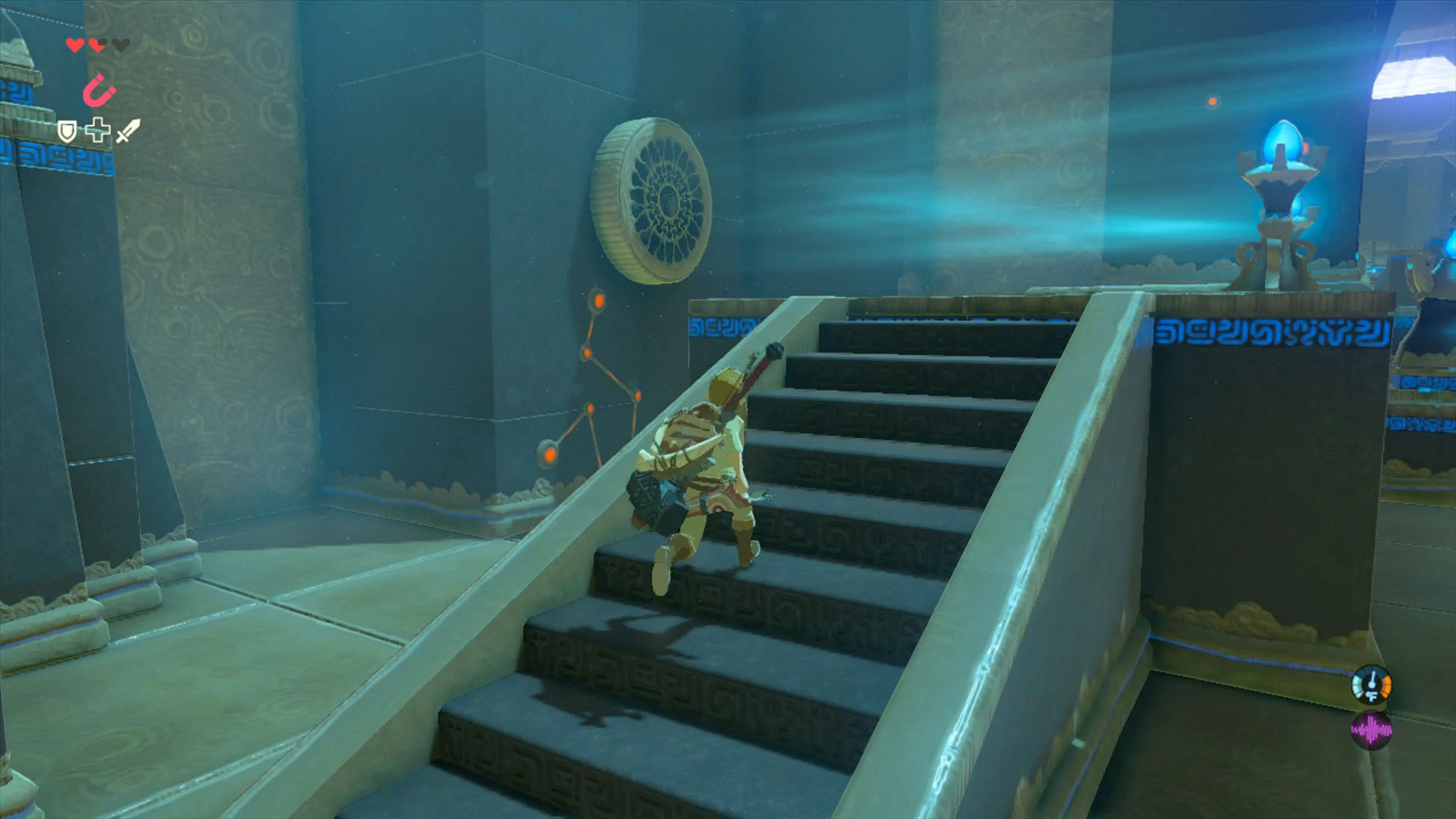
A wind puzzle in a shrine
To make up for the lack of dungeons, there are 120 'shrines' scattered all over the world. These are sort of like dungeons, but are very short, focusing on one concept for a puzzle. Some are very short, with just one puzzle, and others can be longer, with 5 or 6. I actually liked the concept of shrines, because the puzzles were always very unique and creative, and required some real thinking. In some other Zelda games, dungeon puzzles often were as simple as sliding block puzzles, so this was welcome.
Abilities
At the beginning of the game, Link gains a few core abilities that are used all throughout the game, from traversing the world to aiding in combat to solving puzzles in shrines. Remote Bombs are energy blasts which Link can detonate from a distance. Magnesis lets him manipulate metal objects through the air. Stasis locks an item in place for a short time. During this time, one thing Link can do is hit the object repeatedly to build up force, causing the object to experience the combined force once Stasis runs out. Cryonis makes a pillar of ice rise from a body of water, which can lift up gates, help Link traverse water, etc.
I love the abilities because using them in tandem creates some really interesting puzzles, combat methods, and even exploits.
Story/Characters (champions)
In Breath of the Wild, Link wakes up in a preservation chamber 100 years after a great calamity struck Hyrule. During that calamity, there were four "champions" who helped Link and Zelda (try to) defeat Ganon. They died in the struggle, but through memories and ghostly apparitions, the player gets to know each of the four champions. They're strong characters, in my opinion.
Mipha
Mipha is a member of the sea-dwelling Zora race, and she had a crush on Link since their childhood together. She is quiet and shy, but she shows resilience in the face of danger. I like how she is dedicated to helping Zelda even though she knows Link has feelings for Zelda. Mipha is said to be quite handy with a spear, and she pilots the elephant divine beast Vah Ruta. I'm not a huge fan of her voice actor, though.
Revali
Revali is a Rito, a race of bird people. He's arrogant, but lovable at the same time. He resents Link for being the Hero of Legend, believing himself to be more skilled than Link is. When Link meets Revali's spirit after completing the dungeon in Revali's Divine Beast, he finally acknowledges Link's skill. Revali's confidence makes him memorable, and I actually like his voice actor.
Urbosa
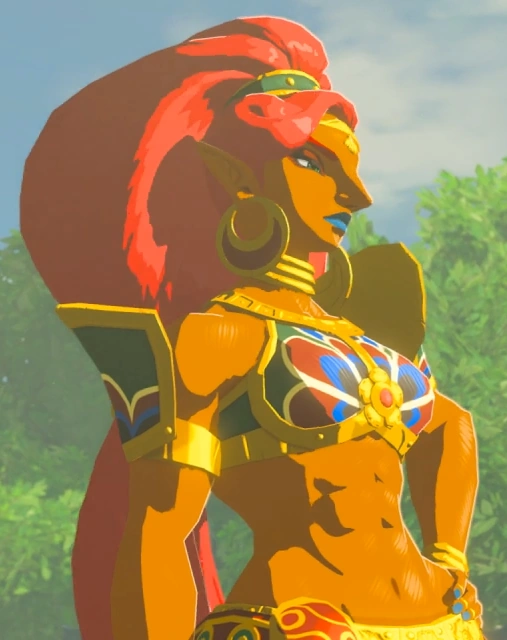
Urbosa is the chief of the Gerudo, a race of women living in the desert. She is seen acting like a big sister to Zelda, and she has some pretty kick-ass lightning powers. In the group of champions, she seems to be the wisest, and the one who maintains order. She also has a surprising hunger for revenge against Ganon, and she relishes the chance to help in defeating him.
Daruk
Daruk is a Goron, a rock creature who lives near the volcano. He's the least developed character, but from flashbacks it can be seen that he acts like a big brother toward Link. There's also a touching scene where Daruk's descendant sees his spirit. The excitement and sadness are almost tangible in the young Goron's expression.
Art
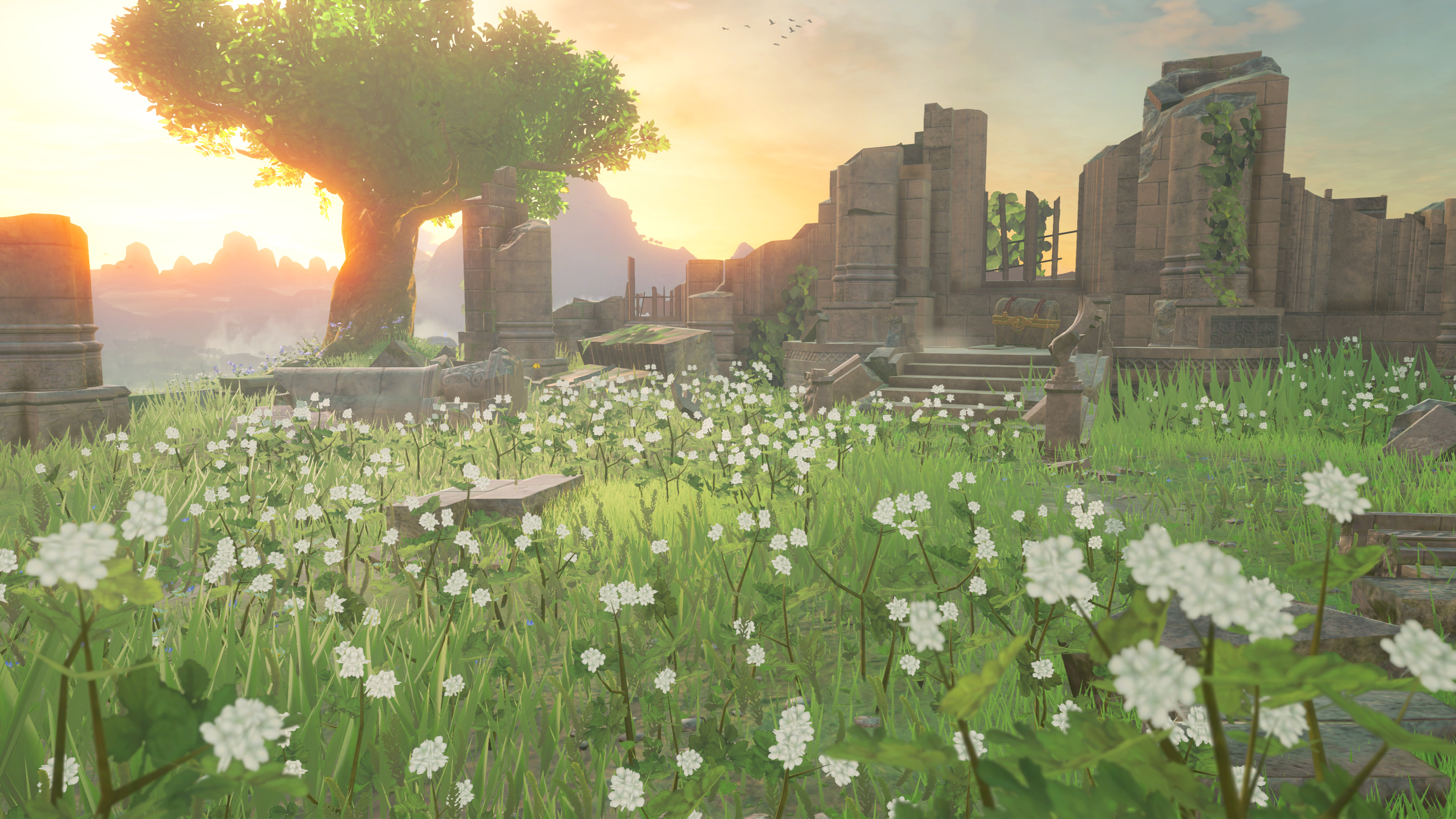
This game uses a cell-shaded graphical style, which I think suits it very well. It looks a lot like Studio Ghibli films, and its style was inspired by traditional Japanese animation.
Ahhhhh
The open world of Breath of the Wild combined with the artstyle make screenshots of this game look like paintings. Any shortcomings in the Nintendo Switch's graphical capabilities are masked by the style.
Be still, my heart
The characters also benefit from the style. The features in their faces are more pronounced, making them more expressive and letting the developers convey emotions with subtleties in the faces.
Part 2
Part two will include Gameplay (combat, food, and quests), Music, and Characters/Story (Zelda and Link). I hope to have it out in a week.
Super Mario Galaxy is a 3D platforming game released for the Wii in 2007. It followed the first two
3D Mario games, Super Mario 64 and Super Mario Sunshine, and compared to those games, the worlds in Super Mario Galaxy are more linear.
The game takes place in outer space, and the main gameplay quirk is the ability to walk around planets using new gravity effects. It also makes use of the Wii's motion controls, as Mario can only perform his spin move when the player shakes the Wii remote (at the time, Nintendo was really pushing the Wii's motion controls).
Also, just a heads up: this game is my favorite game of all time, and because of my many memories associated with this game, I can't promise I will be unbiased. Actually, you can count on me being biased, but bear with me, because I NEED to share why I think this game is so wonderful. Besides, this game is the highest rated game of all time on GameRankings, and the second highest on Metacritic, so I'm far from alone. Without further ado...
Gameplay
As with most Mario games, Super Mario Galaxy is the king of gameplay. Mario travels through 42 galaxies, with multiple missions in most galaxies, to get a Power Star at the.
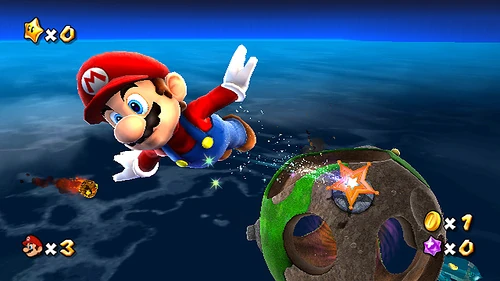
end. He uses a variety of jumps, many of which were in previous games, but what was novel in Super Mario Galaxy was the ability to walk all around the surfaces of the 3D planets, as can be seen below:
Mario has a new move, called the Star Spin, which makes him do a spin when the player shakes the Wii Remote (this was part of Nintendo's push to get motion controls in every single game). But even with the weird controls, the move feels natural, and for me it helped set the game apart from previous Mario games because of all the new moves and mechanics it offered. The spin move is used to screw in giant screws, deflect flying coconuts back at a boss, launch in a launch star from planet to planet, and to extend Mario's jump in midair. This move and the new gravitational mechanics are really what makes up the 'meat' of Super Mario Galaxy.
There are some points in the game where the player is required to point at the screen. By pointing at the screen, the player can collect 'star bits', shoot them at enemies, and pull Mario from place to place using Pull Stars. Unlike the motion controls needed for the spin move, this actually felt a bit forced and unnecessary. Whenever it was required to point at the screen, I felt ripped away from the core gameplay.
Music
The score to Super Mario Galaxy was almost entirely recorded by a full symphony orchestra. It was the first Nintendo game to do so, and they did it perfectly. The sweeping soundtrack really fits the atmosphere of outer space, and I think the score is movie-quality. One song, "Gusty Garden Galaxy", is probably the most well-known Mario song today aside from the songs from the first game, and for good reason:
Not all the music is orchestral, however, as the game also boasts some great electronic-style synth music, especially in galaxies based around artificial structures. Many songs also combine the recorded orchestra music with electronic instruments to create some really interesting music, such as with "Buoy Base Galaxy":
The song starts out with some electronic arpeggios switching between two chords, and then shifts into an orchestral melody for a short while. It switches back and forth a few times, until it reaches a point where the electronic background plays while the sweeping orchestral melody sits on top. Songs like this really fill out the grandiose atmosphere of space.
There are also some musical touches to the game that might not be noticed by the average player. There are certain sound effects in the game that change depending on the music being played. This includes the harp glissando that plays when Mario uses a launch star, and the sound effect that plays when a coin pops out of something. In this game, depending on the chord currently being played in the song, the sound effect will change keys in order to be in harmony with the music at its current spot. Because these sound effects change as the music plays, it almost sounds like they're a part of the music, which really adds to the game's epic atmosphere.
Art/Visuals
Green grass against the dark blue background
Mario Galaxy's visuals are striking for a number of reasons, and one I really noticed is the use of bright, contrasting colors against each other. There are a great many galaxies where the background "sky" (outer space) is a deep blue, which contrasts with the bright green grass of the planets.
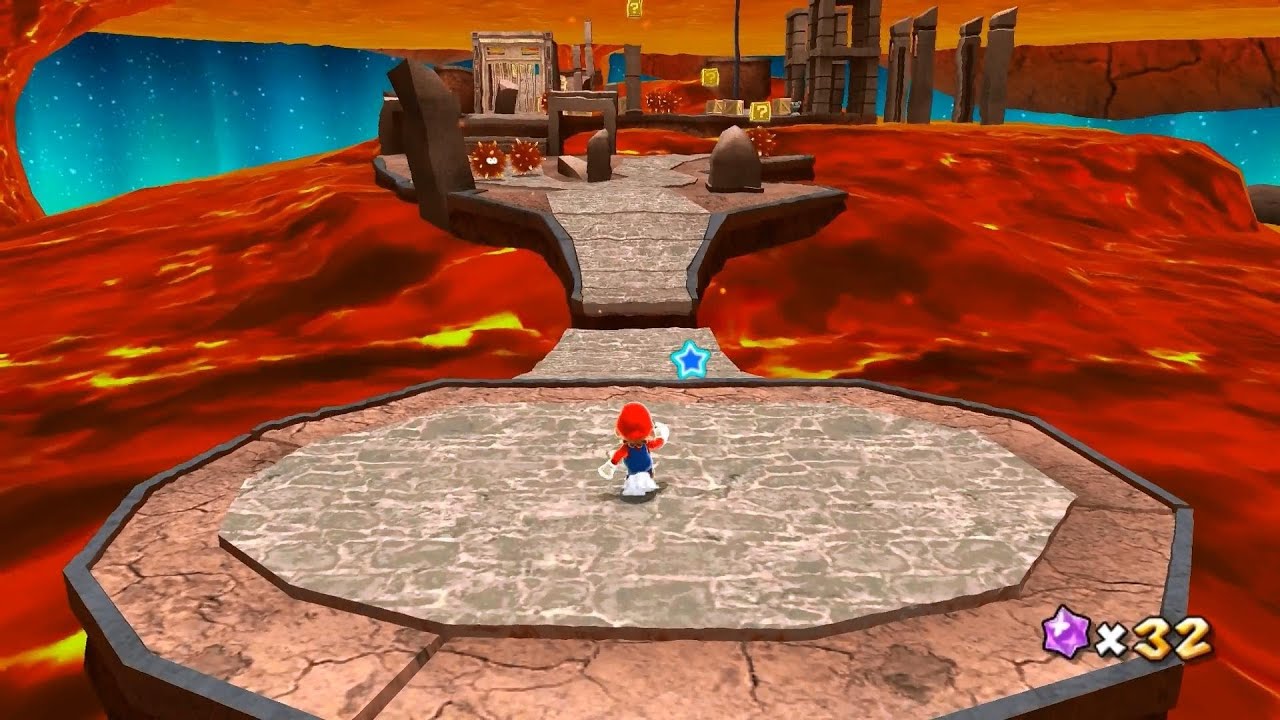
Red magma against the blue-green background
There are also many other uses of beautiful color contrast, such as the deep red magma meeting the surrounding blue-green aurora of the background in the Freezeflame Galaxy.
Super Mario Galaxy hasn't aged perfectly, as it was released on the Wii, which can only output at 480p. While some games are uninhibited by a low resolution, Galaxy doesn't fare the best nowadays, especially on larger screens.
But different aspects of the game make it seem to look better, regardless of the resolution. Everything in the game feels like it has a soft edge, which is not affected by the resolution and gives the game a unifying visual style. Overall though, I feel like the amazing soundtrack picks up the slack of the slightly outdated visuals this game has today.
Story/Characters
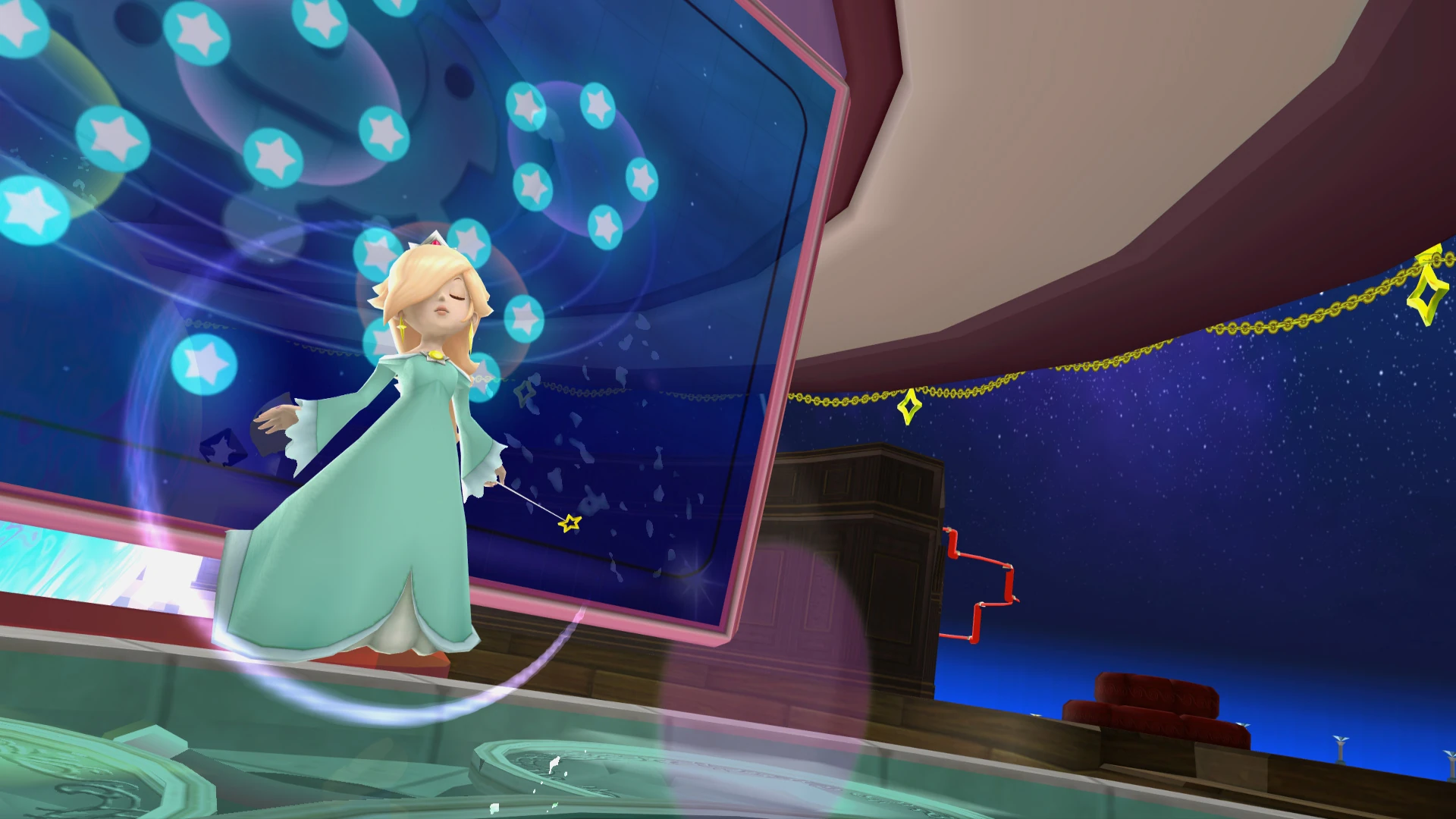
Rosalina on her spaceship, the Comet Observatory
Spoiler alert: Bowser kidnaps Princess Peach. Honestly, no one should be expecting a complicated story from a Mario game, and this one is no exception. Almost. On the surface, this game is about Mario saving Princess Peach from the clutches of Bowser, much like most of the Mario games that came before it. But some will notice that there is a second story going on, a less obvious one, about the mysterious Rosalina, the mysterious woman Mario meets at the beginning of the game, and who lets him stay on her spaceship while he looks for Peach.
Rosalina calls herself the "Mother of the Stars", and acts as a mother to the many star-shaped creatures known as Lumas. Very little is revealed about her initially, but her backstory can be revealed through an optional storybook on the Comet Observatory. Rosalina's Storybook is laid out like a children's book, with simple and elegant language that describes the heartwarming and emotional story of her youth.
The illustrations are also beautifully simplistic, and unlike anything seen before in a Mario game.
My favorite part of the story was Chapter 7: The Telescope. In the previous chapters, the whole story was about Rosalina searching the cosmos for her mother, who was supposedly coming for her on a comet. In this chapter, however, that search quickly comes to an end, as the music changes, and a memory resurfaces:
She twisted the knob of the telescope, and the blue dot grew until she could make out a grassy hill dotted with flowers. It seemed very familiar to her. Zooming even closer, a terrace on the hill came into view. "I used to go stargazing there when I lived on my home planet."
She remembered rubbing the sleep out of her eyes as she followed her father up that hill to look at the stars...
She remembered how she and her brother would sled down that hill...
She remembered having picnics with her mother on that hill on bright and windy days... And...
"I want to go home! I want to go home right now!" The girl burst into tears, and the Lumas didn't know what to do. "I want to go home! I want to go back to my house by the hill! I want to see my mother!" The girl was shouting now, her face wet with tears. "But I know she's not there! I knew all along that she wasn't out there in the sky! Because...because..."
"She's sleeping under the tree on the hill!" The girl's cries echoed through the stars, and a hush fell over the area.
I remember when I read the Storybook for the first time, and my eyes welled up as I read that. The perfect combination of the music shift, the beautiful art, and the eloquent storytelling clicked for me.
Impact/Context
Super Mario Galaxy was released to near universal critical acclaim back in 2007. Even when it was released, untouched by nostalgia, fans and critics alike knew it was something special. The Nintendo Wii, the fifth-best selling video game console of all time, sold 101 million units, and 1 out of every 4 Wii owners owned Super Mario Galaxy. This means there are more people who will have fond childhood memories of Galaxy than its predecessors, Super Mario 64 and Super Mario Sunshine.
Speaking of those games, Super Mario Galaxy marked a shift in direction for the 3D Mario series. While 64 and Sunshine featured more open, non-linear worlds, Galaxy's missions were much more linear, with the player being limited to certain parts of each galaxy for different missions. Because Super Mario Galaxy was so amazing, fans of the 3D Mario series had few objections to the shift, but as the following 3D Mario games became more linear, they began to object. (Responding to those objections, the newest 3D Mario game returns to the style of the first games)
Notes
YAY! My favorite game! Next up is Bayonetta 2, which should be interesting. I'm probably going to have a whole section about Controversy for that game, so stay tuned.




.png/revision/latest?cb=20170113152343)